
Table of Contents
- What Luxury Residential Electrical Design Services Actually Cover
- Smart Home Automation Installation: Lighting, Climate and Security on One System
- Bespoke Lighting Design Services: Scenes, Layers and Daylight Control
- Electrical Infrastructure Planning for Renovations and New Builds
- Certified KNX and Nice Installers: Why Certification Changes the Outcome
- Matching Luxury Residential Electrical Design to Your Project Type
- What Ongoing Support Looks Like After Installation
- Frequently Asked Questions
Last Updated: September 16, 2026
What Luxury Residential Electrical Design Services Actually Cover
Luxury residential electrical design services cover the full lifecycle of a high-end property’s electrical and smart systems, from initial circuit planning through to final commissioning and handover. At AME Electrical, we treat the electrical installation as the backbone of the whole home, not a set of sockets added at the end of a build.
That distinction matters more than most homeowners expect. A standard rewire follows a pattern: cables in, accessories on, certificate issued. A luxury residential electrical design brief starts with how the house will actually be lived in, then works backwards to the infrastructure that supports it.
From First Fix to Final Commissioning
The process moves through five clear stages:
- Consultation and brief – room-by-room requirements, device schedules, and lifestyle mapping
- Design and documentation – circuit schedules, cable routes, control topology, and load calculations
- First fix – containment, cabling, and back boxes installed before plastering
- Second fix and commissioning – accessories, panels, programming, and scene setting
- Handover and support – documentation, training, and ongoing maintenance
Each stage locks in decisions that become expensive to reverse later. Getting the design right at stage two is what separates a system that still works in ten years from one that needs ripping out.
Smart Home Automation Installation: Lighting, Climate and Security on One System
Smart home automation installation works best when lighting, heating, cooling, blinds, and security share a single control platform rather than running as separate apps on separate hubs. One interface, one set of schedules, one point of failure to monitor.
The practical difference shows up daily. A single system can dim the kitchen lights, drop the blinds, and arm the perimeter when you leave, because the subsystems talk to each other. Four disconnected apps cannot do that without manual intervention every time.
Making Existing Devices Work Together
A common mistake is assuming everything must be replaced. Many properties already have smart bulbs, thermostats, or cameras in place, and a well-designed integration can often bring those devices under one roof rather than discarding them. The honest caveat: some consumer-grade hardware simply will not integrate cleanly, and we will say so at survey stage rather than after installation.
Cheap smart hubs and cloud-dependent devices are the most common cause of systems that “just stop working” after a couple of years. If a device needs the manufacturer’s server to function, its useful life is tied to that company’s survival. Wired, locally controlled systems avoid this trap entirely.
Bespoke Lighting Design Services: Scenes, Layers and Daylight Control
Bespoke lighting design services plan light in layers: ambient, task, accent, and feature. Each layer is controlled independently, then combined into scenes that suit different times of day and different activities.
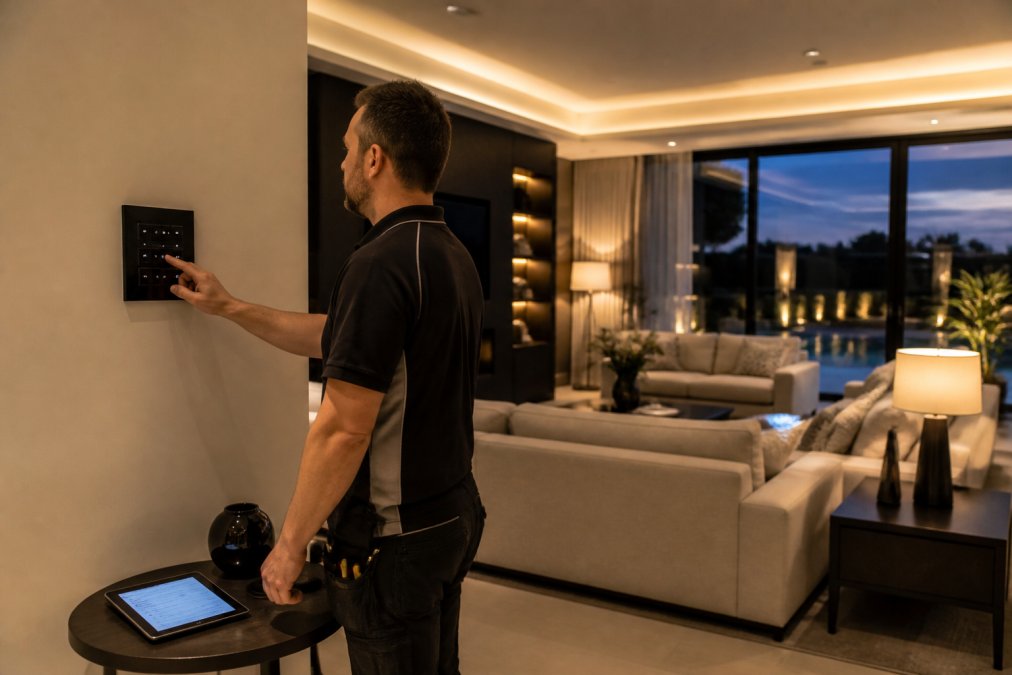
Daylight control is the layer most homeowners underestimate. Automated blinds and tunable white lighting that shifts colour temperature through the day make a measurable difference to how a room feels, particularly in south-facing spaces that get harsh afternoon sun.
The scenes themselves should be named for how you live, not for the technology: “Dinner”, “Film”, “Morning”, “Away”. If a scene needs explaining to a guest, it is not finished.
Electrical Infrastructure Planning for Renovations and New Builds
Electrical infrastructure planning determines how much capacity, containment, and control cabling a property will have for the next twenty years. It is the least visible part of the job and the most expensive to get wrong.
For renovations, the constraint is usually existing structure: where cables can physically run, and how much disruption the client will accept. For new builds, the constraint is coordination with other trades, since first fix has to land before plasterboard goes up.
A short summary of how planning priorities differ:
| Project Type | Main Constraint | Planning Priority | Typical Lead Time |
|---|---|---|---|
| New build | Trade sequencing | Containment and spare capacity | Before first fix |
| Full renovation | Existing structure | Cable routes and disruption limits | Before strip-out |
| Partial renovation | Live property | Phased works and temporary supply | At design stage |
| Listed building | Consent and fabric | Concealment and reversibility | Early, pre-application |
Spare capacity is the cheapest insurance in the whole project. Conduit and draw wires cost very little at first fix and save a fortune when requirements change.
Certified KNX and Nice Installers: Why Certification Changes the Outcome
Certified KNX and Nice installers have completed manufacturer-recognised training and can commission, document, and support the systems they install to the standard those platforms require. Certification is not a badge for marketing; it determines whether the system can be properly programmed and maintained.
KNX is an open international standard, which means devices from different manufacturers can coexist on one installation and any trained integrator can service it (What is KNX?). That openness is the reason it outlives proprietary alternatives. Nice covers access control, gates, and door entry, and integrates with the wider system rather than sitting apart from it.
The thing nobody tells you about certification is what it means at year five, not year one. When something needs adjusting or a device needs replacing, an uncertified installer may have to guess at the original programming. A certified integrator has the tools and documentation to work on it directly.
Matching Luxury Residential Electrical Design to Your Project Type
Luxury residential electrical design should be scoped to the building, not to a template. A Georgian country house, a city apartment, and a listed cottage each present different constraints, and the design response should differ accordingly.
Country Houses, Apartments and Listed Buildings
Country houses typically have the space for plant rooms, structured cabling, and generous containment, but long cable runs and outbuildings create their own challenges. Apartments are the opposite: limited ceiling voids, shared risers, and leasehold restrictions on what can be altered. Listed buildings add a consent layer, where every surface-mounted item may need justification and reversibility becomes a design principle.
On listed properties, plan for surface-mounted containment to be painted to match the fabric and for every intervention to be reversible. It costs more at design stage and saves months of negotiation later.
What Ongoing Support Looks Like After Installation
Ongoing support is what keeps a smart system performing years after handover. It typically covers remote diagnostics, scheduled maintenance visits, firmware and programming updates, and a clear route to a callout when something fails.
The question worth asking any installer before you sign is simple: what happens in year three when a device fails? If the answer involves waiting on a manufacturer’s support queue with no local documentation, the system is more fragile than it looks.
AME Electrical provides ongoing support as part of its service, with documented system records and a relationship-driven approach rather than a handover-and-disappear model. For clients coming from a previous system that failed, that continuity is usually the deciding factor.
Frequently Asked Questions
What is included in a luxury residential electrical design plan?
A full plan covers circuit and containment layouts, lighting positions and scene programming, data and network cabling, security and access control points, and climate control interfaces. It also sets out the control system architecture, so every device has a defined role before first fix begins. AME Electrical handles the whole process, from consultation and design through to installation and ongoing support, which means one team owns the outcome rather than several trades working to separate drawings.
How does smart home automation installation work with devices I already own?
Existing kit such as Philips Hue or basic automation hubs can often stay in place. A KNX-based system can sit alongside these devices, either controlling them directly or coordinating them through a central interface, so you are not forced to rip everything out. The practical route is a survey first: an installer reviews what you have, confirms what can be integrated, and flags anything that genuinely cannot join the system before any work starts.
What standards must luxury electrical installations meet in the UK?
Residential electrical work in the UK must comply with BS 7671, the IET Wiring Regulations, and notifiable work needs to be certified through a competent person scheme or building control. Where a property has specific requirements, such as listed status or a designated use, additional rules can apply. Ask any installer for their certification details and how they will evidence compliance at handover, including test results and certificates for the completed installation.
How do I ensure my electrical system is future-ready?
Plan for capacity you are not using yet. That means generous cable runs to key locations, spare ways in distribution boards, structured network cabling rather than relying on Wi-Fi alone, and a control platform that accepts new devices without a full rebuild. KNX is an open standard, so products from multiple manufacturers can join the same system over time. It is far cheaper to install this capacity during a renovation than to retrofit it afterwards.
Modern luxury properties ask a lot of their electrical systems, and the gap between a well-planned installation and an improvised one only widens over time. AME Electrical designs and installs integrated electrical and smart home systems as certified KNX and Nice installers, covering consultation, design, installation, and ongoing support for private and commercial clients. Get a quote from AME Electrical and start with a design that still works in ten years.