
Table of Contents
- What Is an Integrated Home Security System Design?
- How to Automate Home Security Without Cloud Dependency
- Smart Home Security Integration Best Practices
- Luxury Residential Security System Components
- Standards and Compliance for Residential Security Design
- Planning Your Integrated Home Security System Design
- Why Professional Integration Matters for Reliability
- Frequently Asked Questions
Last Updated: September 20, 2026
What Is an Integrated Home Security System Design?
An integrated home security system design is a cohesive approach to combining multiple security, access control, and monitoring technologies into a single unified platform that operates seamlessly across your property. Rather than installing isolated systems that don’t communicate, an integrated design connects cameras, door locks, motion sensors, alarm panels, and lighting into one controllable ecosystem.
Homeowners installing fragmented security solutions often face frustration within months. A camera system that doesn’t talk to your access control. Motion sensors that trigger lights but not alarms. Separate apps for every device. The real value of integrated design isn’t the individual components, it’s the intelligence that emerges when they work together.
According to the UK National Security Inspectorate’s guidance on residential security systems, properly designed integrated systems reduce response times to security events and improve overall property protection by creating a comprehensive view of what’s happening across your home. This matters because security isn’t just about installing equipment; it’s about creating a system that responds intelligently to threats.
How to Automate Home Security Without Cloud Dependency
Many homeowners worry that modern security automation means surrendering control to cloud services, where data travels to distant servers and system failures become someone else’s problem. That’s not the only way to build automation.
Local-first automation keeps decision-making on your property. Your system processes sensor data, triggers actions, and maintains security protocols entirely within your own infrastructure. If your internet connection drops, your security continues working. If a cloud service goes down, your automation doesn’t pause.
Implementing local automation requires three core elements. First, choose a control platform that supports local processing, systems built on open standards like KNX allow devices to communicate directly without cloud intermediaries. Second, ensure your network infrastructure is strong enough to handle real-time communication between devices without latency issues. Third, design your automation rules to execute locally: when motion is detected at the front door, the system immediately activates lights and records footage without waiting for cloud confirmation.
The practical benefit is reliability. You’re not dependent on your internet service provider’s uptime or a third-party company’s infrastructure decisions. Your security system remains autonomous and responsive, regardless of external factors.
Smart Home Security Integration Best Practices
Designing for integration means thinking about how each component communicates with others before installation begins. Too many installations treat security as an afterthought, bolting systems onto existing electrical infrastructure without considering future expansion or cross-system intelligence.
Start with a clear audit of what you actually need to monitor and control. Not every room requires cameras. Not every door needs electronic access control. Identify the genuine security vulnerabilities specific to your property, entry points, blind spots, areas where you need visibility or automated response. This prevents over-specification and keeps your system maintainable.
Next, standardise on communication protocols. If your access control uses one wireless standard, your cameras use another, and your motion sensors use a third, integration becomes fragmented. Systems built on unified standards like KNX or Nice protocols allow all components to share information without translation layers. This simplicity reduces failure points and makes future upgrades straightforward.
Documentation during design is often overlooked but essential. Record every device, its location, its configuration, and how it connects to the broader system. When something fails or needs maintenance months later, clear documentation means faster diagnosis. It also protects you if you eventually sell the property, buyers value homes where they can understand how systems work.
Luxury Residential Security System Components
High-end residential security typically combines five key categories of components, each serving a distinct function within the integrated whole.
Access control manages who enters and when. Electronic locks on doors, gates, and internal rooms communicate with a central controller that logs every entry. Biometric readers, keypads, or mobile credentials replace traditional keys. The system can be programmed to allow access only during certain hours, revoke credentials instantly, or trigger alerts if someone attempts unauthorised entry.
Surveillance provides visual verification of events. IP cameras with local recording store footage on your property rather than relying on cloud storage. Motion-triggered recording conserves storage space while ensuring you capture relevant events. High-resolution sensors work effectively in low light, essential for perimeter monitoring.
Intrusion detection uses door and window sensors, glass-break detectors, and motion sensors to identify unauthorised entry attempts. These devices communicate instantly with your control panel, triggering alarms and notifications before an intruder progresses further into your property.
Lighting integration amplifies security by removing dark areas where someone might hide. Motion-activated lights deter potential intruders and improve visibility for your own cameras. Automated lighting also creates the impression of occupancy when you’re away, a simple but effective deterrent.
Environmental monitoring extends security to include fire, flooding, and gas detection. These sensors integrate with your access system, if smoke is detected, doors unlock automatically to allow safe exit. If water is detected in a basement, the system alerts you immediately.
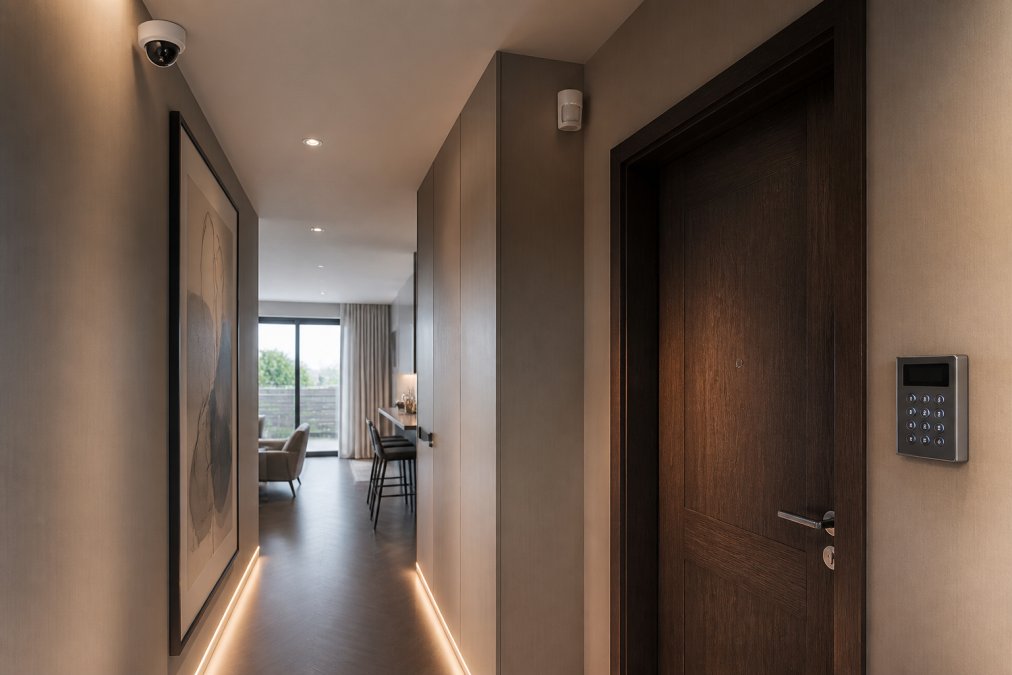
Professional installation ensures each component is positioned for optimal coverage and performance. A camera installed in the wrong location captures nothing useful. A motion sensor placed too high misses activity at ground level. This is where design expertise matters, understanding sight lines, signal propagation, and how components interact in your specific property.
Standards and Compliance for Residential Security Design
In the UK, residential security installations aren’t subject to the same regulatory frameworks as commercial properties, but professional standards still apply. The British Standards Institution’s guidance on security system design recommends following established practices even for private homes, particularly when systems include fire detection or access control.
KNX certification represents the gold standard for integrated home automation. Systems certified to KNX standards have undergone rigorous testing to ensure interoperability, reliability, and security. When you work with certified KNX installers like AME Electrical, you’re choosing a system built on proven international standards rather than proprietary locked-in ecosystems.
Nice certification applies specifically to access control and gate automation. Nice-certified products meet strict requirements for safety, security, and durability. This matters because access control failures can compromise your entire security posture, a lock that fails in the open position is worse than no lock at all.
Insurance providers increasingly ask about system design when assessing risk. A professionally designed, standards-compliant system provides evidence that your security was designed with expert knowledge rather than assembled from consumer-grade components.
Planning Your Integrated Home Security System Design
Effective planning begins with three foundational questions: What are you protecting? From what threats? What’s your tolerance for false alarms and system complexity?
Start by mapping your property. Mark all entry points, identify areas requiring visibility, note potential blind spots, and consider where devices should be positioned for optimal coverage and aesthetics. For luxury properties, security shouldn’t look like a prison, cameras and sensors should integrate discreetly into the architecture.
Next, define your automation logic. When motion is detected at the front gate, what should happen?
Why Professional Integration Matters for Reliability
Installing security components yourself is technically possible. Connecting them so they work reliably together is a different challenge entirely.
Frequently Asked Questions
What are the main benefits of an integrated home security system design?
An integrated home security system design consolidates multiple security functions, access control, CCTV, alarm monitoring, and smart locks, into one unified platform. This eliminates compatibility issues, reduces false alarms through intelligent verification, and allows you to control everything from a single interface. You gain better visibility across your property, faster response times to threats, and simplified management compared to piecemeal systems installed separately.
How do you design a security system that works without cloud dependency?
Local-network security systems use KNX or similar protocols to operate independently of internet connectivity. All processing, storage, and control happen within your home network using a local hub or control panel. This approach eliminates reliance on external servers, improves response times, and protects your data from cloud breaches. However, it requires careful planning during the design phase to ensure all components communicate via the same protocol and that your network infrastructure supports real-time operation.
What components are essential for a luxury residential security setup?
A comprehensive luxury residential security system includes professional-grade cameras with high-resolution recording, hardwired access control systems for doors and gates, motion sensors with pet immunity, environmental sensors for fire and water detection, a central control panel with battery backup, and integrated smart locks. Additional components might include glass-break detection, perimeter sensors, and integration with lighting automation for security deterrence. The specific components depend on your property layout and security priorities.
What UK standards should my residential security design meet?
Residential security installations should adhere to relevant British Standards for CCTV systems, intruder detection, and access control. Electrical safety must meet Building Regulations, and data protection for any recorded footage falls under GDPR. Professional installers familiar with these standards ensure your system is compliant and insurable.
Can an integrated security system work with existing smart home devices I already own?
Integration depends on the protocol your existing devices use. KNX-based systems can incorporate compatible third-party devices through gateways, but mixing protocols often requires additional bridges or compromises. A professional design assessment can identify which of your current devices can be retained and which components need replacement for seamless integration. Starting with a unified protocol from the outset, rather than adding devices piecemeal, prevents future compatibility headaches.
How much ongoing support do I need after a security system is installed?
Integrated security systems benefit from regular maintenance to ensure all components function reliably. This includes firmware updates, battery testing in backup systems, camera lens cleaning, and periodic system audits to catch configuration drift. Professional support contracts typically cover emergency response, remote diagnostics, and preventative maintenance. Without ongoing support, system reliability degrades over time, particularly with wireless components and cloud-dependent features.
What’s the difference between professional integration and DIY smart security?
Professional integration involves system design tailored to your property’s layout, load calculations, compliance verification, and coordinated installation of all components. DIY approaches often result in isolated devices that don’t communicate effectively, poor coverage, and no guarantee of compliance with building standards. Professional installers also provide documentation, training, and support, whereas DIY systems typically leave you managing troubleshooting alone when issues arise.