
Table of Contents
- KNX vs Standard Electrical Wiring: The Core Differences
- KNX vs Standard Wiring: Feature Comparison Table
- KNX Wiring Topology: Why the Layout Matters
- KNX Cable Explained: What Goes Behind the Walls
- Pros and Cons of KNX and Standard Electrical Wiring
- KNX Installation in Existing Homes: What a Retrofit Involves
- KNX Lighting Control and System Integration
- Frequently Asked Questions
Last Updated: 6 October 2026
KNX vs Standard Electrical Wiring: The Core Differences
The choice between KNX vs standard electrical wiring comes down to one question: do you want a fixed set of switches, or a system you can reprogram without touching a cable? At AME Electrical, we install both, and the honest answer is that conventional wiring still wins on simplicity and upfront cost, while KNX wins on flexibility, integration and long-term control.
A conventional circuit is a closed loop. Power runs from the consumer unit, through a cable, to a switch, and on to a light or socket. The switch is the control. If you want that switch to do something else, you rewire it.
A KNX bus system separates control from power. Mains voltage still feeds the loads, but the commands travel separately on a low-voltage data cable that links sensors, actuators and a central power supply. The KNX Association’s technical overview explains the open standard behind it, which is why devices from different manufacturers can sit on the same bus.
That single architectural difference explains almost everything else in this comparison.
How a Conventional Circuit Works
Standard wiring is radial. Each circuit runs from the distribution board to its outlets, and each switch is physically connected to the load it controls. A two-way landing light needs strapper cables between the switches. Add a third control point and you add more cable.
It is strong, well understood, and any competent electrician can fault-find it. The limitation is that the wiring is the logic. Changing how the building behaves means changing the copper.
How a KNX Bus System Works
In a KNX installation, a push-button sends a telegram onto the bus. A dimming actuator receives it and adjusts the circuit. The button and the light are not electrically connected at all, they simply share an address in the commissioning software.
That is why one button can trigger a lighting scene, drop the blinds and set the heating back. It is also why you can reassign that button later with a laptop rather than a chisel.
KNX vs Standard Wiring: Feature Comparison Table
The table below summarises the practical differences most clients ask us about during consultation.
| Feature | Standard Wiring | KNX Bus System |
|---|---|---|
| Control method | Physical switch per circuit | Addressed sensors and actuators |
| Changing function later | Rewire required | Reprogrammed in software |
| Multi-room scenes | Very limited | Native |
| Blinds, HVAC, security | Separate systems | Single integrated network |
| Cable runs to switches | Mains cable to every switch | Bus cable, typically 4-core |
| Fault finding | Simple, familiar | Needs KNX-trained diagnosis |
| Upfront cost | Lower | Higher |
| Best for | Straightforward layouts | Integrated, high-spec projects |
KNX Wiring Topology: Why the Layout Matters
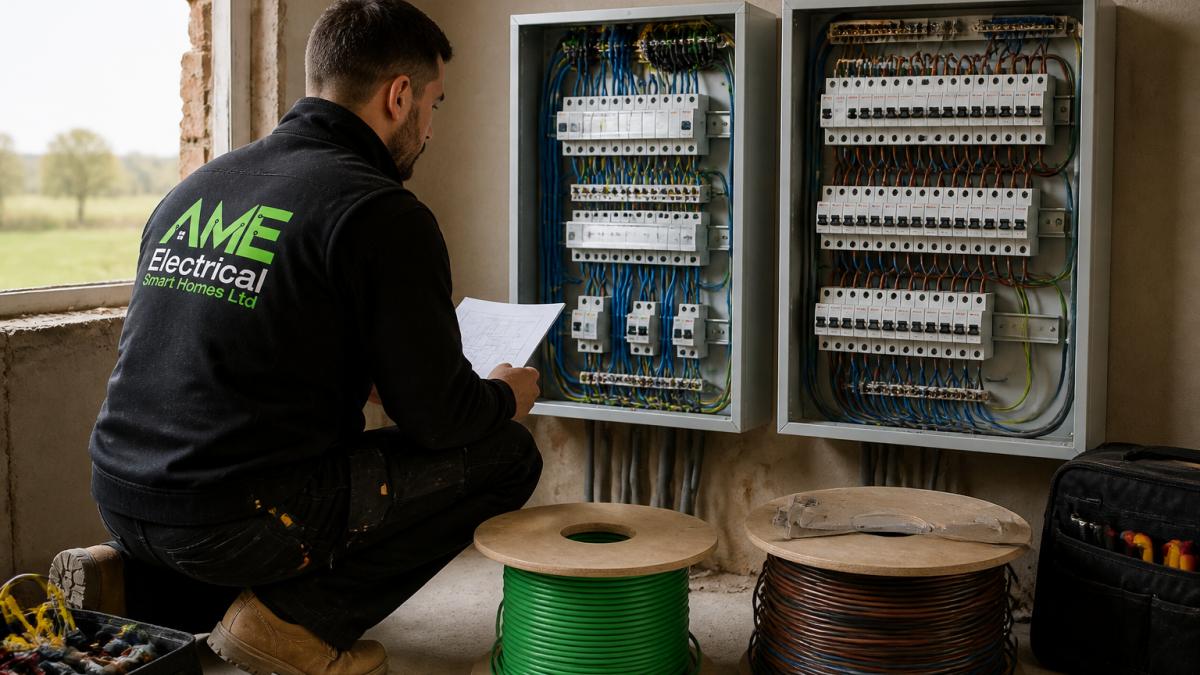
KNX wiring topology is arranged in a hierarchy of lines, areas and a backbone, and that structure is what keeps a large installation manageable. A single line supports up to 64 devices, and couplers join lines into larger systems.
Conventional wiring has no equivalent. It grows by adding circuits to the board, and the board becomes the bottleneck.
For a large house or a hotel floor, the difference shows up in the containment. Bus cable is daisy-chained from device to device, so you are not pulling a separate mains feed to every switch position. That reduces cable volume and, in a refurbishment, reduces the amount of chasing and making good.
Keep bus cable away from mains cable where you can. Induced interference on a long parallel run is one of the few things that causes intermittent, hard-to-trace faults on an otherwise sound KNX installation.
KNX Cable Explained: What Goes Behind the Walls
KNX cable is a twisted-pair bus cable, usually green, carrying both data and 24V power to the devices. It is not mains cable and it is not interchangeable with it.
Two details matter in practice. First, the bus is typically wired in a line or tree, not a ring, and loops back on itself cause communication failures. Second, the cable is polarity-conscious, so the pair must be landed the right way round at every device.
The mains side still exists. Lights, sockets and heating actuators all need 230V feeds from the consumer unit. KNX changes how those loads are controlled, not whether they need power.
The most common mistake we see on retrofit surveys is a bus cable run in the same conduit as a mains feed for the whole length of a corridor. It usually works on day one and then throws random device dropouts months later, which is expensive to trace once the walls are closed.
Pros and Cons of KNX and Standard Electrical Wiring
Neither system is universally better. The right answer depends on how much the building will need to adapt over its life.
Advantages of KNX
- One control layer for lighting, blinds, heating and access
- Functions change through software, not rewiring
- Scenes and schedules reduce energy waste in commercial spaces
- Open standard, so devices are not tied to a single manufacturer
- Scales cleanly from a single line to a multi-area building
Advantages of Standard Wiring
- Lower material and labour cost on straightforward layouts
- Any qualified electrician can work on it
- Fewer commissioning steps before handover
- Easier to extend with a single extra circuit
- No dependency on software or a specialist to make changes
The trade-off is real. A conventional installation is cheaper to build and cheaper to understand. A KNX installation costs more upfront and asks more of the installer, but it does not need to be torn open the first time a client wants the kitchen lights to behave differently.
KNX Installation in Existing Homes: What a Retrofit Involves
KNX installation in existing homes is entirely possible, and most of our retrofit work happens during a wider renovation rather than as a standalone job. The bus cable has to reach every switch and actuator position, so access is the deciding factor.
A typical retrofit sequence looks like this:
- Survey the existing circuits and identify what stays on conventional control
- Plan bus routes alongside the first-fix electrical layout
- Pull bus cable to switch positions, actuators and the panel
- Install the KNX power supply, actuators and interface modules
- Commission the system and program addresses, scenes and schedules
- Test every group address and hand over the documentation
Where floors are being lifted or walls opened anyway, the additional disruption is modest. Where a property is finished and occupied, we will often recommend a hybrid approach: KNX for the areas that matter most, conventional wiring elsewhere.
KNX Lighting Control and System Integration
KNX lighting control is where most clients first notice the difference. Dimming, colour temperature and scene recall all sit on the same bus as the blinds and the heating, so a single “evening” command can set the whole room.
Integration is the other half of the argument. Because KNX is an open protocol, it can talk to access control, AV and building management through gateways. For hospitality clients, that means reception can set a floor to a welcome scene, and housekeeping can trigger a setback state from the same interface.
This is the part of the system that outlives the decoration. Lighting preferences change, room layouts change, and the bus does not care. At AME Electrical, we design and commission KNX systems as certified installers, and we stay involved after handover because a system nobody can adjust is a system nobody uses.
If the building will be reconfigured within its lifetime, the wiring decision is really a decision about future cost. Standard wiring front-loads savings; KNX front-loads capability.
Every project reaches the same crossroads: the first time a client wants the lighting to do something the original wiring was never designed for. That is the moment the choice between KNX and standard wiring stops being theoretical. AME Electrical designs, installs and commissions integrated KNX systems, with certified KNX and Nice installers, a single team handling consultation through to ongoing support, and lighting and climate control configured around how you actually use the space. Get a quote and we will tell you honestly which approach suits your building.
Frequently Asked Questions
What is the difference between KNX wiring and standard electrical wiring?
Standard wiring runs mains power directly to each switch and appliance, so every function needs its own circuit. KNX wiring separates power from control: mains cable still feeds lights, sockets and heating, but a separate low-voltage bus cable carries commands between devices. That means one bus cable can operate lighting, blinds, heating and security together, and functions are changed in software rather than by adding new circuits.
Does KNX use different cables from conventional electrical wiring?
Yes. Alongside the usual mains cabling, KNX uses a dedicated twisted-pair bus cable, typically the green two-core KNX cable, which carries both data and power to devices such as switches, sensors and dimmer actuators. Mains cable still supplies the loads themselves. Because the bus cable is low voltage, it can be run in series from device to device without the deep switch drops conventional wiring needs.
Can KNX be installed in an existing property?
KNX installation in existing homes is possible, and it suits renovations where walls or ceilings are already being opened up. A full rewire gives the cleanest result because bus cable can be routed properly. In partial retrofits, installers often use KNX-compatible devices that sit on existing wiring, or wireless KNX options, then extend the bus as further rooms are refurbished. A site survey confirms what is practical before work starts.
Does KNX still work if the internet goes down?
Yes. KNX is a decentralised bus system, so devices communicate directly with each other over the bus cable rather than through the cloud. Lighting, heating, blinds and scenes keep working normally during an internet outage. You would only lose remote access from a phone or voice assistant until the connection returns. This is one of the main reasons KNX is chosen for hotels, restaurants and homes where reliability matters.