
Last Updated: 26 November 2026
Quick Summary
Design restaurant lighting in layers, starting by mapping each zone and service period. Combine ambient, task and accent light, then choose warm colour temperatures for dining rooms, cooler light for kitchens, and set up dimmable scenes for each service.
- Split the restaurant into zones and note each one’s use, mood and service periods before choosing fittings.
- Layer ambient, task and accent light so the room does not look flat or uniformly lit.
- Use 2700 K to 3000 K in dining areas and 4000 K to 5000 K in the kitchen and back-of-house.
- Check glare from a seated guest’s eye level and aim accent lights at walls rather than faces.
- Set up lunch, dinner, cleaning and closed lighting scenes, and test them at full service.
Table of Contents
- Why Lighting Decides How a Restaurant Feels
- Step 1: Map Your Zones and Service Periods
- Step 2: Plan the Restaurant Lighting Layout in Layers
- Step 3: Choose Restaurant Lighting Colour Temperature and Brightness
- Step 4: Select Fixtures and Restaurant Lighting Ideas by Area
- Step 5: Set Up Restaurant Lighting Controls and Scenes
- Checklist and Next Step: Book a Lighting Design Consultation with AME Electrical
- Frequently Asked Questions
Why Lighting Decides How a Restaurant Feels
Restaurant lighting is the fastest way to change how a room feels, and it works before a guest reads a single word on the menu. Lighting is part of the design, not an afterthought fitted once the walls are painted.
Lighting shapes atmosphere in a few practical ways:
- Mood: Warm, low light makes people feel relaxed and at ease.
- Comfort: Glare and harsh shadows make guests tense and want to leave sooner.
- Appearance: Good light makes food, drinks, skin tones and interiors look their best.
- Zoning: Light tells guests where to sit, where to walk and where the focal points are.
Restaurant lighting ideas only work when they fit the room and the way it is used. The steps below take you from planning zones to setting up controls, so you can build a plan you can check against your own space.
Step 1: Map Your Zones and Service Periods
Start by splitting the restaurant into zones. A dining room, bar, entrance, kitchen pass and toilets each need different light levels and moods.
Then map the service periods. A breakfast room, a busy lunch and a candlelit dinner ask for very different settings.
- List each zone: Dining, bar, entrance, corridors, toilets, kitchen pass.
- Note the use: Reading menus, eating, working, moving through.
- Set the mood: Relaxed, lively, focused, or welcoming.
- Plan each service: Lunch, afternoon, early evening, late dinner.
Write this down before choosing any fittings. It gives you a clear brief, and it stops you from lighting every area the same way.
Watch out: Do not light a whole room to one brightness level.
Step 2: Plan the Restaurant Lighting Layout in Layers
A good restaurant lighting layout uses several layers of light working together. One light source on its own almost always looks flat.
Ambient, task and accent light explained
- Ambient light: The general light that fills the room. It sets the base brightness and should be soft and even.
- Task light: Focused light for reading menus, preparing drinks and working at the bar or kitchen pass.
- Accent light: Light that highlights features such as artwork, shelving, a feature wall or the bar back.
Layering these three gives you control. For a closer look at how comparable hospitality spaces are lit, see the boutique hotel smart lighting guide for options and energy savings. You can keep ambient light low for a dinner service and add accent light to make the room feel designed rather than dim.
Watch out: Accent lights set too bright or too close to a table can create glare in guests’ eyes. Aim them at walls and features, not faces.
Step 3: Choose Restaurant Lighting Colour Temperature and Brightness
Colour temperature is measured in kelvin (K). Lower numbers give a warm, amber glow. Higher numbers give a cooler, bluer white.
A practical starting point is to set targets by zone rather than picking one colour for the whole building:
- Dining room: 2700 K to 3000 K for a warm, inviting mood. Use the lower end for dinner and intimate spaces, the upper end for lunch and brighter daytime service.
- Bar and lounge: 2400 K to 2700 K for a cosy, low-lit feel, with accent light doing the work rather than general brightness.
- Entrance and circulation: 3000 K to 3500 K so guests can see where they are going without the space feeling clinical.
- Kitchen and back-of-house: 4000 K to 5000 K for crisp, neutral light that helps staff judge food and work safely.
- Toilets: 3000 K to 3500 K, bright enough to feel clean and safe without being stark.
Colour rendering matters as much as colour temperature.
Brightness should match the zone and the service. Keep dining areas softer than the kitchen and make sure guests can read the menu without straining.
Watch out: Mixing colour temperatures in one sightline, such as a 2700 K pendant next to a 4000 K downlight, makes a room look accidental.
The table below sets out the suggested colour temperature for each zone, as described in this step.
| Zone | Colour temperature | Note |
|---|---|---|
| Dining room | 2700 K to 3000 K | Warm, inviting mood; lower end for dinner |
| Bar and lounge | 2400 K to 2700 K | Cosy, low-lit feel; accent light does the work |
| Entrance and circulation | 3000 K to 3500 K | Guests can see the way without feeling clinical |
| Kitchen and back-of-house | 4000 K to 5000 K | Crisp, neutral light for judging food and safe work |
| Toilets | 3000 K to 3500 K | Bright enough to feel clean and safe |
Colour temperature
Step 4: Select Fixtures and Restaurant Lighting Ideas by Area
Choose fittings for each zone, based on the layer each one provides, and check each choice for visual comfort as well as appearance.
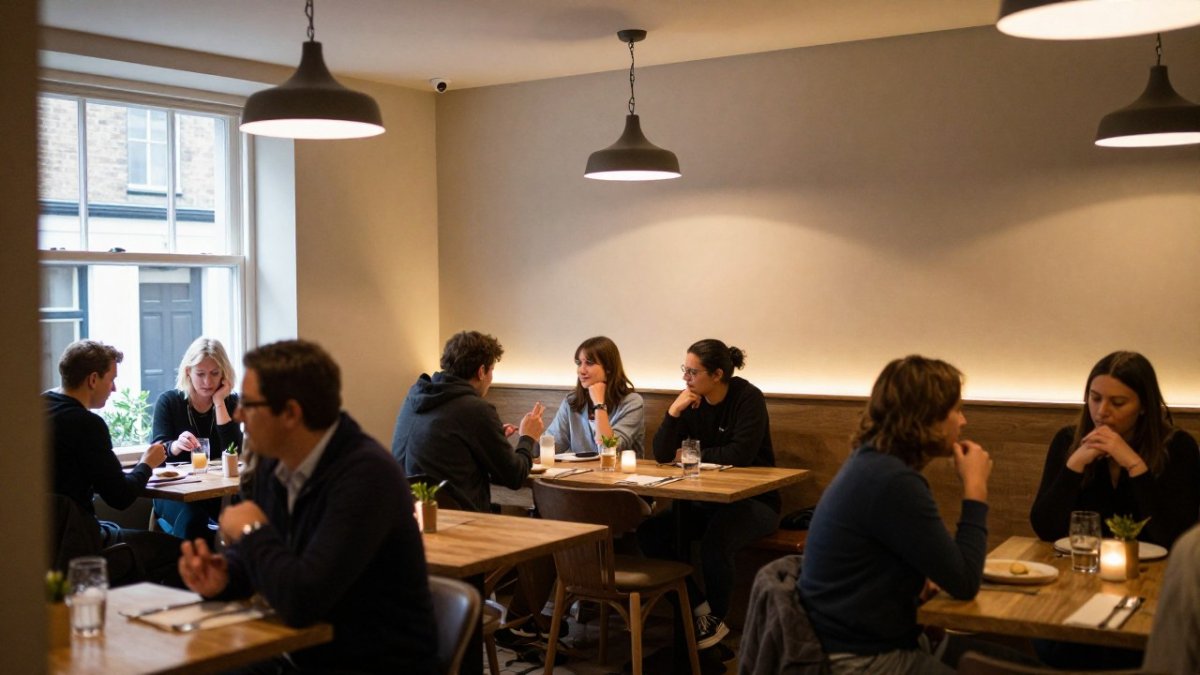
- Dining room: Pendant lights over tables give focused warmth. Wall lights add soft ambient glow. Set pendants low enough to pool light on the table but high enough that guests are not looking into the lamp.
- Bar: Task lights under shelves or above the counter help staff work. Accent lights behind the bar draw the eye. Shield the lamps so guests seated at the bar do not see the source directly.
- Entrance: Bright enough to welcome guests and show the way, but not harsh on arrival. A gradual transition from a brighter entrance to a softer dining room helps eyes adjust.
- Feature walls: Wall washers or spotlights highlight texture and artwork. Angle them so the beam grazes the surface rather than hitting guests’ faces.
- Toilets and corridors: Clear, even light that feels safe without being stark. Avoid deep shadows that make steps and doorways hard to read.
Downlights are useful for general light, but place them carefully. A row of bare downlights over every table can feel like an office, so pair them with dimmable fittings and softer shades. Recessed downlights with deep baffles or anti-glare louvres reduce the brightness a seated guest sees, even when the fitting is doing the same job.
Designing for visual comfort and accessibility
Glare, contrast and flicker matter more than most operators expect, especially for older guests and people with visual impairments. A room that looks atmospheric in a photograph can be difficult to navigate in person.
- Control glare at seated eye level. Check every fitting from the height of a seated guest, not standing. A lamp that is comfortable to look at from above can be painful from a chair.
- Keep contrast manageable. A very bright entrance next to a very dark dining room forces eyes to readjust. Use intermediate light levels in corridors and at thresholds.
- Avoid flicker. Cheap dimmers paired with incompatible LED drivers cause flicker that is invisible to some guests and uncomfortable for others. Check compatibility and test at low levels.
- Light steps and changes of level. Older guests and people with visual impairments rely on contrast to read floor edges. Make sure stairs, ramps and thresholds are lit clearly.
- Give menus and signage enough task light. Small text and low contrast are harder to read as eyes age. A little focused light at the table or on the menu helps without raising the whole room.
Watch out: Decorative bare lamps and exposed filaments look striking, but they are a direct glare source for anyone seated nearby. Use them as accents away from eye level, or choose diffused versions.
Step 5: Set Up Restaurant Lighting Controls and Scenes
Controls turn a good plan into a room that changes with the day. Set up lighting scenes so staff can switch between service periods with one button.
- Lunch scene: Brighter ambient light, accent lights lower.
- Dinner scene: Lower ambient light, warmer colour, accent lights on.
- Cleaning scene: Bright, even light across the whole room.
- Closed scene: Security and wayfinding lights only.
Dimming is the simplest control to add and makes the biggest difference. Check that your dimmers and LED drivers are compatible, so fittings do not flicker when turned low.
Commissioning matters too. Test each scene at full service with real tables and real people, then fine-tune the levels. A scene that looks right on an empty floor can feel too dark once guests arrive.
For more on this, see Smart Lighting Control Systems Reviewed for Luxury Homes and Hospitality Lighting Control vs Standard Switches Compared. A real example of a hospitality lighting control upgrade is covered in Intelligent KNX & DMX Lighting Control Upgrade at Hilton Templepatrick Hotel.
Checklist and Next Step: Book a Lighting Design Consultation with AME Electrical
Use this checklist before you buy any fittings:
- Zones and service periods mapped
- Ambient, task and accent layers planned for each zone
- Colour temperature chosen for each area (warm for dining, cooler for kitchens)
- Colour rendering checked for food and materials
- Glare checked at seated eye level
- Lighting scenes set for each service period
- Dimming and controls tested at full service
Designing restaurant lighting for ambience takes planning, but a clear brief makes the job much simpler. At AME Electrical, we design and install lighting control, from the first plan through to commissioning the scenes. Get a quote from AME Electrical to discuss your zones, service periods and controls. You can also explore our KNX lighting control service, which offers wired scenes, dimming and sensor-based lighting that works without relying on wifi.
Frequently Asked Questions
How do you create ambience with restaurant lighting?
Start by layering three types of light: ambient light for general visibility, task light where guests and staff need to see clearly, and accent light to highlight feature walls, artwork and tables. Keep the overall level low and warm, then add focal points so the eye moves around the room. Use dimmers or lighting scenes so the mood can shift from lunchtime to dinner service without re-wiring. Testing the room at night with the full lighting plan switched on is the most reliable way to judge the atmosphere before handover.
What colour temperature is best for restaurant lighting?
For most dining rooms, a warm white in the region of 2700 K to 3000 K gives an inviting, relaxed feel that flatters skin tones and food. Cooler light around 4000 K can suit a bright breakfast or café area, but it tends to feel clinical in an evening dining room. Choose fixtures with a high colour rendering index (CRI), ideally 90 or above, so that food and interior finishes look true to colour. Keep the same colour temperature across fixtures in one space to avoid a patchy appearance.
What types of lighting are used in restaurants?
Most restaurants combine ambient or general lighting, task lighting over bars, prep and counters, and accent lighting that highlights artwork, shelving or architectural features. Decorative lighting, such as pendant lights and wall lights, adds character and also contributes to the general light level. Downlights are useful for even coverage but work best when combined with other fixture types so the room does not feel flat. The right mix depends on the concept, the service periods and the size of each zone.
How bright should restaurant lighting be?
Brightness should vary by zone and by time of day. Dining areas usually work best at a relatively low, comfortable level in the evening, with tables lit enough to read a menu and see food clearly. Bars, entrances and service areas typically need higher levels for safety and clarity. Dimming controls let you reduce output during quieter periods without changing the fittings. Measure or simulate light levels in each zone during the design stage so the plan is based on figures rather than guesswork.
