
Last Updated: 12 November 2026
Quick Summary
Hospitality lighting control is a networked system that manages light across a hotel through preset scenes, occupancy sensing and centralised programming, rather than relying on individual wall switches. A standard switch asks a guest to make one decision at a time, while a control system makes dozens of decisions for them.
- Scene recall sets multiple circuits to predetermined levels with one button press.
- Occupancy sensors should fail to a sensible state rather than leaving a space dark.
- Keep local switching behind every scene panel so a network fault does not strand guests.
- Specifying controls before confirming existing drivers are dimmable causes flicker in practice.
- A survey of the property is the sensible starting point before any credible payback figure.
Table of Contents
- Hospitality Lighting Control vs Standard Switches: The Core Difference
- Hotel Lighting Control Systems: What They Actually Do
- Guest Room Lighting Controls and the Guest Experience
- Hotel Lighting Scenes: Arrival Mode, Sleep Mode and Reading Light
- Commercial Lighting Control Systems in Event Spaces and Function Rooms
- Energy Consumption, Operating Costs and Measurable Outcomes
- Reliability, Manual Override and Retrofit Constraints
- Planning Your Lighting Control Upgrade with AME Electrical
- Frequently Asked Questions
Hospitality Lighting Control vs Standard Switches: The Core Difference
Hospitality lighting control is a networked system that manages light across a hotel through preset scenes, occupancy sensing and centralised programming, rather than relying on individual wall switches.
That distinction matters commercially. Research into how occupants perceive lit environments and interact with lighting controls, published in Lighting Research & Technology, shows that user experience with controls shapes whether a lighting scheme performs as designed.
At AME Electrical, we install KNX control systems for hotels and commercial premises. Below, we compare the two approaches on cost, comfort, energy and reliability, and explain where each one genuinely belongs.
Hotel Lighting Control Systems: What They Actually Do
Hotel lighting control systems centralise the management of lighting circuits through a programmable network, allowing scenes, schedules and sensors to operate together. A standard switch simply opens or closes a circuit. A control system coordinates many circuits at once and can respond to time, occupancy or a single button press.
The practical difference shows up in three areas:
- Scene recall: one button sets multiple circuits to predetermined levels
- Sensing: occupancy and daylight sensors adjust lighting without input
- Monitoring: the system reports which areas are lit and when
Manual Control, Automatic Control and Occupancy Sensing
Manual control keeps the guest in charge: they press a switch and the light responds. Automatic control removes that decision, dimming a corridor at 2am or raising bathroom lighting as someone enters. Most well-designed hotels use both, with automatic behaviour in back-of-house and corridors, and manual override available everywhere a guest might want it.
Occupancy sensing is where the energy case is strongest. As CSE’s guidance on networked lighting controls notes, controls can supply occupancy data and accurate lighting-usage information, which is what makes energy reduction measurable rather than assumed.
Guest Room Lighting Controls and the Guest Experience
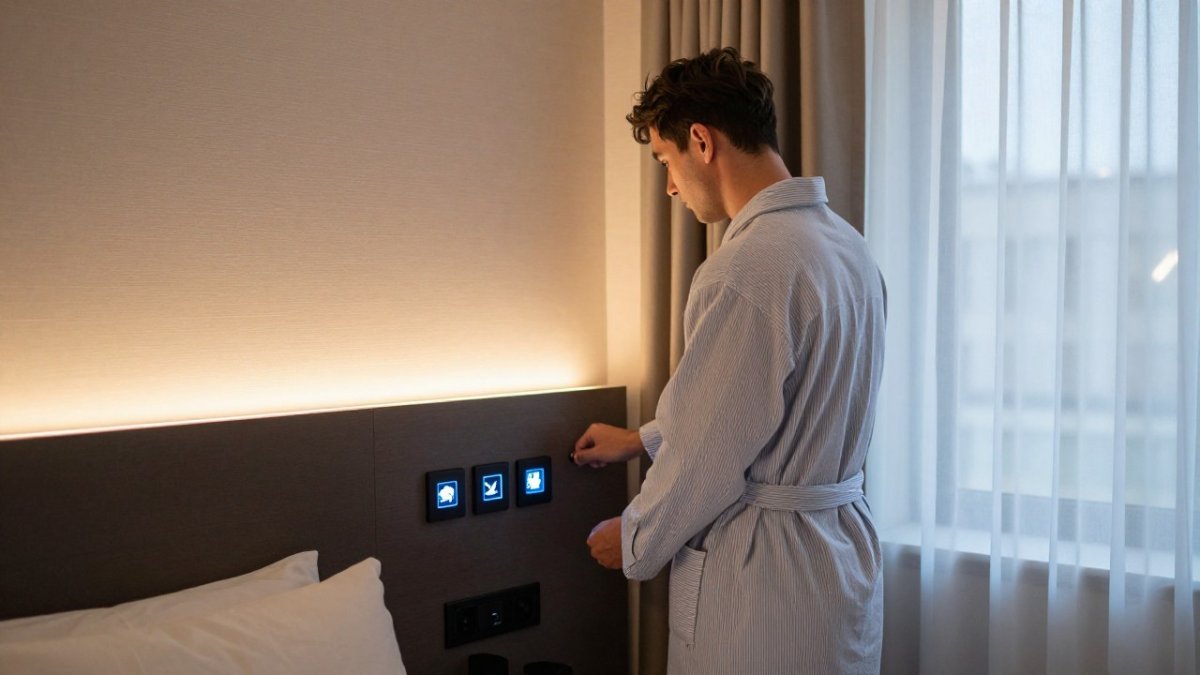
Guest room lighting controls determine whether a room feels considered or confusing within the first thirty seconds of arrival. A guest arriving at midnight wants one thing: enough light to orient themselves without hunting for a switch bank.
What most guides miss is that guests do not read instructions. If the control interface needs explaining, it has already failed.
Ease of Use, Control Placement and Accessibility
Control placement decides usability more than the technology does. Switches reachable from the bed, a panel beside the door at hand height, and bathroom lighting that does not require crossing a dark room all matter. Accessibility matters too: controls mounted at a consistent height, large tactile buttons and voice control options make a room usable for guests with limited mobility or vision.
For a deeper look at how these choices play out room by room, our guide to smart lighting for boutique hotels covers the options and integration points.
Hotel Lighting Scenes: Arrival Mode, Sleep Mode and Reading Light
Hotel lighting scenes are preset combinations of brightness and colour temperature that set a room’s atmosphere with one command. Examples include an arrival mode, a sleep mode and a reading light.
The value is consistency. A scene removes the guesswork from a guest’s evening and protects the room’s design intent from being overridden by every occupant.
Our guide to smart home systems for boutique hotels explains the core guest scenes to set up first and how lighting connects to blinds, heating and access control in the same room.
Commercial Lighting Control Systems in Event Spaces and Function Rooms
Commercial lighting control systems earn their place fastest in event and function rooms, where a space may host a wedding breakfast, a conference and a dinner in the same week.
That flexibility is difficult to replicate with standard switches. A partitioned room with four switch panels and no scene control forces staff to reset lighting manually between events, and mistakes are visible to clients. Preset scenes for presentation, dining and turnaround reduce that risk and cut setup time.
Energy Consumption, Operating Costs and Measurable Outcomes
Energy savings from lighting control come from three places: lights switched off when rooms are empty, dimming rather than full output where daylight allows, and scheduled reduction in corridors and back-of-house. The ACEEE’s 2024 commercial lighting market report examines how the commercial lighting market is shifting toward controls, though it does not publish a single savings figure that applies to every building.
Savings depend on occupancy patterns, existing lamp types and how disciplined the current manual practice is, so a survey of the property is the sensible starting point.
Building a Like-for-Like Cost Comparison
A useful exercise is to put both options on the same spreadsheet. Do it line by line, because the headline equipment price is the least informative number in the comparison.
- Upfront equipment: standard switches are inexpensive per point; a networked control system carries the cost of controllers, sensors, scene panels, gateways and power supplies, and that cost scales with the number of circuits and rooms rather than the number of switches.
- Installation labour: switches are a straightforward first-fix item. Controls add commissioning time, addressing devices, building scenes, setting sensor behaviour and documenting the configuration, which is a real labour line that is easy to omit from a quote.
- Maintenance and replacement: dimming and soft-start reduce lamp replacement frequency, and LED luminaires driven below full output generally last longer. Against that, control hardware itself has a service life and may need firmware or device replacement over a ten-year horizon.
- Energy spend: the saving is the difference between what the property consumes now and what it consumes with occupancy sensing, daylight dimming and scheduling in place. It is measurable only if the existing consumption is metered first.
- Staff time: manual resets between events, corridor checks and room turnaround all consume labour. Scene recall and centralised scheduling reduce that time, and it belongs in the comparison as a cost avoided.
Payback Assumptions That Hold Up
Payback is simply the upfront and installation cost divided by the annual saving, and the annual saving is the sum of energy, lamp replacement and staff-time reductions. The trap is treating any one of those as certain.
A common pattern is that the energy line alone rarely justifies a full networked retrofit in a property with modest occupancy and already-efficient lighting, while the combination of energy, reduced maintenance and staff time does justify it in larger properties with function space, long corridors and high room turnover.
Our article on smart hotel energy management sets out how controls deliver savings and what to plan for.
Reliability, Manual Override and Retrofit Constraints
Reliability separates a good control system from an expensive irritation. The failure modes to design against are predictable: a network fault taking out a whole floor, a scene panel failing with no local switch behind it, or a guest unable to turn off a light at 3am.
Manual override at the point of use is a basic resilience measure, so a guest should never be stranded by a controller.
Designing for Failure
The engineering answer is to keep the control layer and the lighting circuit separate enough that a control failure does not become a lighting failure. In practice that means:
- Local switching behind every scene panel: the panel sends a command, but a physical switch or relay at the luminaire still works if the network is down.
- Fallback behaviour on sensors: occupancy sensors should fail to a sensible state, usually on in circulation areas and off in unoccupied rooms, rather than leaving a space dark or lit permanently.
- Segmented networks: dividing control across floors or wings limits the blast radius of a single fault, so one failed device does not take out the whole building.
- Documented override procedure: housekeeping and reception staff need to know how to restore basic lighting without calling an engineer at midnight.
A guest should never be stranded by a controller, and staff should never be dependent on a laptop to turn a corridor light on.
Retrofit Constraints and Installation Disruption
Retrofit constraints are the other practical hurdle, and they decide whether a scheme is viable before any product is chosen.
The realistic options are:
- Wired retrofit: the most robust long-term result, but it needs containment routes and usually a room-by-room programme timed around occupancy.
- Wireless or hybrid: avoids much of the cabling, but carries trade-offs in long-term support, battery replacement and interoperability between manufacturers.
- Phased rollout: starting with function rooms or a single floor proves the design and spreads disruption and cost across budget cycles.
Compatibility with existing luminaires matters too.
Watch out: specifying the control system before confirming that the existing drivers and lamps are dimmable is the most common cause of a retrofit that works on paper and flickers in practice.
A real example of what a full upgrade involves is our KNX and DMX lighting control project at Hilton Templepatrick, which shows the scope in practice.
| Consideration | Standard switches | Hospitality lighting control |
|---|---|---|
| Upfront cost | Lower | Higher |
| Energy management | Manual only | Automated and measurable |
| Guest experience | Basic | Scene-based, consistent |
| Flexibility between events | Limited | High |
| Failure impact | Single circuit | Needs override design |
| Retrofit disruption | Minimal | Moderate to significant |
Planning Your Lighting Control Upgrade with AME Electrical
A successful upgrade starts with a survey, not a product list. We assess the existing wiring, the room types, how staff actually use each space, and where manual override must remain.
As certified KNX and Nice installers, we work across private and commercial properties and provide ongoing support, so the system stays configured as your building evolves. If you are weighing up the change, get in touch to discuss your requirements and request a quote.
The decision between standard switches and a control system is rarely about technology for its own sake. It is about whether your building can deliver consistent guest comfort, measurable energy management and flexible spaces without adding staff workload.
Frequently Asked Questions
What is the difference between lighting controls and standard light switches?
Standard switches simply break or complete a circuit, so a light is either on or off. Hospitality lighting control systems add dimming, preset scenes, occupancy sensing and timed lighting, often across several circuits from one panel. A dimmer switch is a partial step towards control, but it still works one fitting at a time. The practical difference is that controls manage the room as a whole rather than individual lamps.
Are lighting control systems worth it for hotels?
It depends on the property. Controls earn their place where guests notice comfort, where energy bills matter and where rooms change use, such as function rooms that combine for events. Networked lighting controls can provide occupancy data and lighting-usage information, which can support energy reduction. For a small guesthouse with simple rooms, standard switches plus dimmers may be the more sensible spend.
How do lighting scenes work in hotel rooms?
A scene sets several circuits to fixed brightness levels at once. Arrival mode might bring up ceiling and bedside lighting, sleep mode drops everything to a low night lighting level, and a reading light scene raises only the bedside fitting. Guests select a scene with one button instead of adjusting four dimmers. Scenes are stored in the control system, so the same button behaves identically in every room, which helps housekeeping and maintenance.
Can hotel lighting controls reduce energy use?
Controls give you more ways to avoid waste: occupancy sensors switch off unoccupied rooms, timed lighting clears back-of-house areas, and dimming cuts consumption when full output is not needed. Savings depend on the property, so treat any percentage claim with caution. Pairing controls with LED lighting matters more than the control layer alone. Ask your installer to model consumption room by room rather than quoting a generic saving.
