
Table of Contents
- What a Professional Home Automation Consultancy Actually Does
- Benefits of Professional Smart Home Installation
- Smart Home System Design Services: What Good Design Looks Like
- How to Plan a Smart Home Electrical Infrastructure
- How to Choose a Professional Home Automation Consultancy
- Questions to Ask Before You Sign Anything
- Common Mistakes to Avoid
- Conclusion
- Frequently Asked Questions
Last Updated: September 13, 2026
What a Professional Home Automation Consultancy Actually Does
A professional home automation consultancy designs, specifies and oversees the installation of integrated smart systems for a building, rather than simply selling you devices to plug in. At AME Electrical, that work starts long before anyone drills a hole: we survey the property, map how you actually live in it, and translate that into a system architecture that lighting, heating, security and audio can all share.
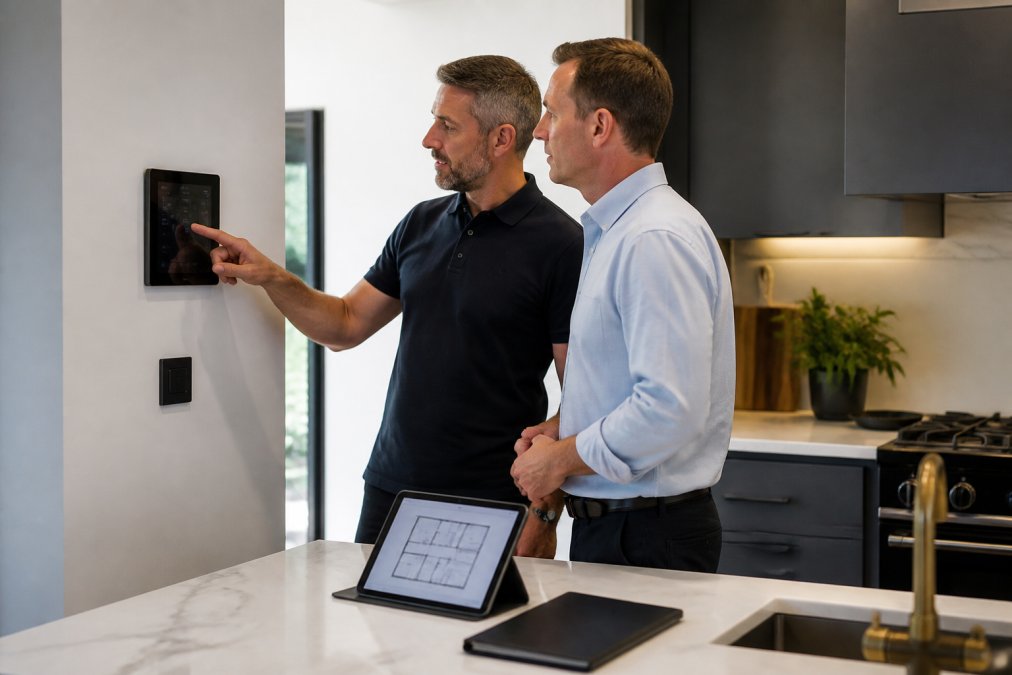
Most homeowners arrive at this point backwards. They buy a few smart plugs, add a video doorbell, then wonder why nothing talks to anything else. A consultancy exists to stop that happening.
The real value isn’t the technology. It’s the decisions made before the technology is chosen.
From First Survey to Handover
The process follows a consistent shape, though the detail changes with every property:
- Discovery survey – room-by-room walkthrough, noting construction, cable routes and how each space is used
- Brief and specification – what you want to control, from where, and how it should behave day to day
- System design – device schedules, wiring diagrams, containment routes and control philosophy
- Installation – first fix, cabling, containment, then second fix and commissioning
- Programming and handover – scenes, schedules, user training and documentation
A common mistake is treating the survey as a formality. It’s the single most useful hour in the whole project.
Benefits of Professional Smart Home Installation
The benefits of professional smart home installation come down to reliability and coherence: one system that behaves predictably, rather than six apps that each do one thing. Professionally installed systems are also far easier to extend later, because the wiring and network backbone are already in place.
Three things separate a professional install from a DIY one:
- Wiring that anticipates change. Extra capacity in containment and spare cores at key points mean future devices don’t require re-plastering.
- A single control layer. Lighting, climate, blinds and security respond to one another instead of operating in isolation.
- Documented configuration. You receive a record of what was installed and how it was programmed, so any competent engineer can pick it up later.
That last point matters more than people expect. Undocumented systems become expensive to maintain, and that’s how smart homes end up as e-waste.
Ask for the as-built documentation before final payment. A system you can’t hand to another engineer is a system you’re locked into.
Smart Home System Design Services: What Good Design Looks Like
Smart home system design services should produce three deliverables: a device schedule, a wiring and containment plan, and a written control philosophy explaining how the system behaves. If a proposal contains only a list of products, it isn’t a design.
Good design is mostly about restraint. Every added device is another thing that can fail, another thing to update, and another thing someone in the household has to understand. The strongest systems we design are usually the ones with fewer, better-chosen components doing more work.
Where design earns its keep is in the awkward details: how a hallway behaves at 2am, what happens to the heating when a window is left open, whether the alarm can trigger lighting rather than just a siren. These are decisions, not products.
How to Plan a Smart Home Electrical Infrastructure
Planning smart home electrical infrastructure means deciding your cable routes, containment and network topology before first fix, because retrofitting them afterwards is disruptive and costly. Get this stage right and almost everything else becomes straightforward.
Cabling, Containment and Future-Proofing
The practical rules are consistent across most projects:
- Cable to a central point. A structured cabling approach, with home runs back to a plant room or riser, keeps fault-finding simple.
- Separate power and data. Keep mains and low-voltage cabling apart to reduce interference.
- Over-specify containment. Conduit and trunking that’s 30-40% empty at handover gives you room to add later without opening walls (Responsibilities for those in an electrical installation design role webinar).
- Plan the network first. A reliable wired backbone underpins everything wireless, including access points, cameras and control panels.
- Document as you go. Photograph containment before it’s closed up. It will save hours later.
Work of this kind must comply with BS 7671 wiring regulations, and any notifiable electrical work in a dwelling needs to meet building regulations. A consultancy that treats compliance as an afterthought is one to walk away from.
How to Choose a Professional Home Automation Consultancy
Choosing well comes down to evidence: certification, references from comparable projects, and a clear explanation of what happens after handover. Certifications such as KNX Partner status or manufacturer accreditation for specific product ranges are verifiable, so verify them (Getting KNX certified).
What most guides miss is that the best consultancy for a boutique hotel is rarely the best one for a listed cottage. Ask about projects of your type and size, and ask to speak to those clients.
| What to check | Why it matters | Red flag |
|---|---|---|
| Certifications | Proves trained, current competence | “We can do anything” |
| Comparable references | Shows relevant experience | No client contact allowed |
| Design documentation | Confirms a real design process | Product list only |
| Support terms | Determines long-term cost | Vague or verbal only |
| Handover pack | Enables future maintenance | Not offered |
Questions to Ask Before You Sign Anything
Ask directly, and expect specific answers. Vague responses to any of the following are a signal in themselves.
- Can you integrate the devices I already own, or does everything need replacing?
- Who handles programming changes six months from now, and what does that involve?
- What documentation will I receive at handover?
- What happens if a device is discontinued in three years?
- Which parts of this system can I manage myself, and which need an engineer?
That last question is the one that separates a good consultancy from a sales operation. A well-designed system should let you handle everyday changes, while the complex configuration stays with the professionals.
Beware of any proposal that names a single manufacturer for every device without explaining why. It usually means the installer is tied to one supply chain, not that the products are the best fit.
Common Mistakes to Avoid
The most expensive mistake is choosing the technology before the design. Once you’ve committed to a platform, you’ve locked in your options for everything that follows.
Three others come up repeatedly:
- Skipping the network. Smart homes run on networks. A weak or unmanaged network undermines even excellent devices.
- Buying on price alone. The gap between quotes is usually a gap in scope: containment, documentation, commissioning and support.
- No support plan. Systems need occasional attention. Agreeing how that’s handled before installation is far easier than negotiating it afterwards.
A consultancy that raises these points before you do is doing its job properly.
Conclusion
Getting a smart home right is less about the devices and more about the decisions made before anything is installed. That’s where experience tells, and it’s where AME Electrical works: certified KNX and Nice installers, a relationship-driven approach, and support that continues well past handover. We handle the design, installation and ongoing maintenance so the system stays reliable rather than becoming another forgotten project. Get a quote from AME Electrical and start with a survey of what your property can actually support.
Frequently Asked Questions
What does a home automation consultant do?
A consultant surveys your property, agrees how you want each room to work, then designs the wiring, controls and device schedule that deliver it. They coordinate electricians, AV and security trades, commission the system and hand over documentation. With a professional home automation consultancy, one team owns the design and the result, so you are not left chasing separate trades when something does not talk to something else.
How do I choose the best smart home installer?
Check certifications first: KNX Partner status and manufacturer accreditation such as Nice show the installer has been trained on the platforms they sell. Ask for references from projects similar to yours, confirm who handles support after handover, and request a design document before signing. A written scope covering cabling, controls and future expansion separates a professional from someone who simply fits smart switches.
Is professional home automation worth the investment?
It depends on the size and complexity of the project. For a single room, a few smart switches may be enough. For a whole house or a hospitality venue, professional design pays off because lighting, heating, security and audio need to work as one system. A consultant prevents the expensive pattern of buying devices that later cannot be integrated, and proper infrastructure means future upgrades do not require rewiring.
How do I integrate smart technology into a period property?
Period properties can take smart systems, but the design has to respect the building. Consultants route cabling through existing voids and service runs, specify keypads that suit the interior, and avoid chasing walls where it would damage original features. Planning this at renovation stage is far easier than retrofitting later, and it keeps modern controls discreet rather than intrusive.