
Table of Contents
- What Professional Smart Home Maintenance Plans Actually Cover
- The Smart Home System Health Check, Explained
- Smart Home Firmware Update Management
- Smart Home Troubleshooting Services: What to Expect
- How to Choose a Professional Smart Home Maintenance Provider
- Frequently Asked Questions
Last Updated: September 12, 2026
What Professional Smart Home Maintenance Plans Actually Cover
Professional smart home maintenance plans are scheduled service agreements that keep integrated lighting, security, climate and audio systems running correctly through planned visits, firmware management and priority fault response. This guide explains what a genuine maintenance plan includes, what it costs you in time and disruption when you skip one, and how to judge a provider before you sign.
A smart home is not a set of appliances. It is a network, and networks degrade.
Planned Visits vs Reactive Callouts
The core distinction is simple: planned visits prevent faults, reactive callouts fix them after they’ve already cost you an evening.
A planned visit follows a fixed checklist. An engineer tests device response times, checks backup batteries, reviews automation scenes, inspects terminations and confirms the system still does what it was designed to do. You know the date in advance, so there’s no surprise.
Reactive callouts are the alternative, and they’re always more expensive in practice. A failed lighting controller at 9pm on a Friday isn’t a maintenance task, it’s an emergency. The fix is usually quick once someone attends, but the diagnosis takes longer if there isn’t a current record of how the system was configured.
The most common mistake is treating a working system as a maintained one. Smart devices fail silently: a dimmer still switches, but its feedback loop to the controller has stopped reporting. You won’t notice until a scene misfires during a dinner party.
| Plan Element | Planned Visit | Reactive Callout |
|---|---|---|
| Timing | Scheduled in advance | After a fault occurs |
| Cost profile | Predictable, agreed upfront | Unpredictable, often urgent |
| Diagnosis time | Fast, records on file | Slow, configuration unknown |
| System impact | Prevents downtime | Restores after downtime |
The Smart Home System Health Check, Explained
A smart home system health check is a structured inspection of every connected device, its network link and its control logic, carried out on a fixed schedule rather than when something breaks. It typically covers four areas: connectivity, power, software and configuration.
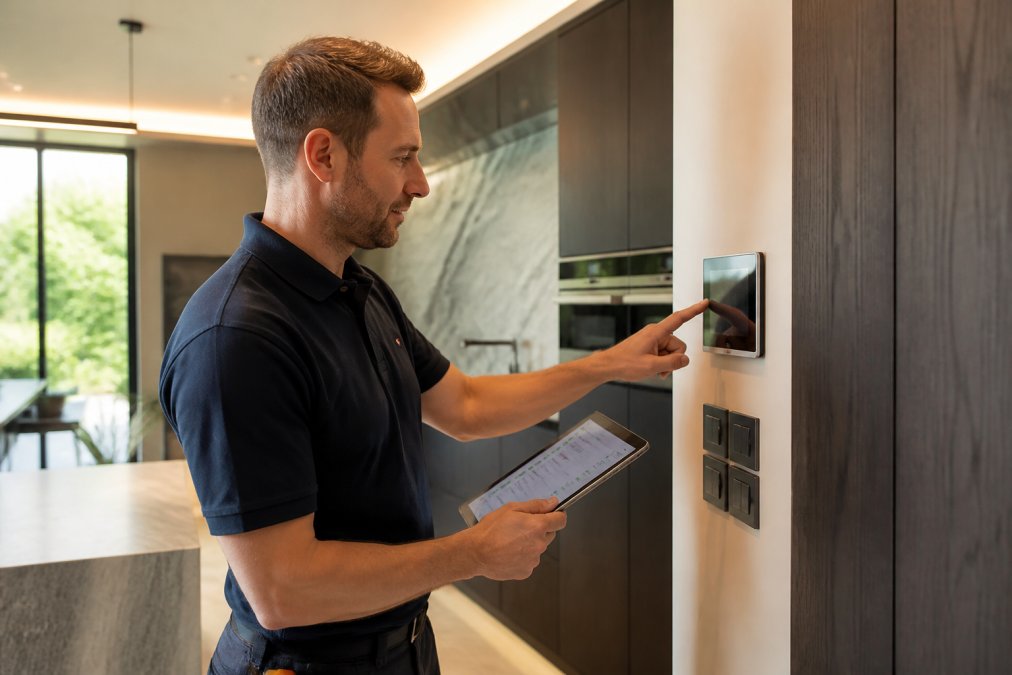
Connectivity checks confirm every device is still reachable on the network and that signal strength hasn’t drifted since commissioning. Power checks cover backup batteries, uninterruptible supplies and circuit loading. Software checks verify version consistency. Configuration checks confirm scenes, schedules and user permissions still match how you actually live in the property.
What most guides miss is that the health check is as much about the client as the kit. A system installed for a family of five behaves differently once two of them move out. Providers can adjust the configuration to match, rather than just confirming everything still powers on.
Ask for a written health check report after every visit. It gives you a dated record of device firmware versions and network addresses, which turns any future fault into a fifteen-minute diagnosis instead of a two-hour investigation.
Smart Home Firmware Update Management
Smart home firmware update management is the controlled process of applying manufacturer software updates to controllers, panels, sensors and drivers without breaking existing automations. It is the single most misunderstood part of any maintenance plan.
Updates fix security vulnerabilities and add device compatibility. They also occasionally change behaviour. A lighting driver update can alter dimming curves (knx.org). A panel update can reset custom scenes. Applying updates blind, on a live system, in a busy household, is how “it worked yesterday” becomes a support ticket.
The sensible approach is staged: test on a non-critical zone first, verify the automations still behave, then roll out across the property. Providers who manage KNX and similar building-control systems often do this routinely, because a KNX installation is a programmed system, not a collection of apps.
That distinction matters. A certified KNX installer understands the project file, the group addresses and the logic behind every scene. That knowledge is what makes safe update management possible. The KNX Association’s guidance on system maintenance sets out why programmed building-control systems need documented, version-controlled maintenance rather than ad-hoc tinkering.
Smart Home Troubleshooting Services: What to Expect
Smart home troubleshooting services cover the diagnosis and repair of faults across lighting, security, climate and audio systems, usually under a priority response commitment. The quality of the service depends almost entirely on how much the provider already knows about your installation.
Here’s what a good response looks like in practice. You report the fault. The provider checks their records for your system’s configuration and firmware state. In many cases they can identify the likely cause before attending, because they know which devices were updated last and which zones have a history of issues.
Expect these elements in a credible troubleshooting commitment:
- A defined response window, not a vague “as soon as possible”
- Remote diagnosis attempted before a site visit where the system allows it
- Written notes added to your system record after every visit
- Clear separation between faults covered by the plan and chargeable work
If a provider can’t tell you what’s in your system file, it can lead to more time-consuming and expensive troubleshooting.
A boutique hotel with a handful of rooms needs the same discipline as a large commercial site, just at a smaller scale. The failure mode is identical: a guest-facing lighting or climate fault that nobody can resolve quickly because the original configuration was never documented.
How to Choose a Professional Smart Home Maintenance Provider
Choosing a provider comes down to four questions: what’s documented, what’s scheduled, what’s covered, and who actually attends.
Start with certification. For integrated systems, look for manufacturer-certified installers rather than general electricians. The Electrical Safety First guidance on choosing a registered electrician is a useful baseline for verifying competence and insurance before you allow anyone to work on your installation.
Then work through this checklist:
- Can they produce a system file or configuration record for your property?
- Is the visit schedule fixed in writing, with dates?
- Does the plan state the response window for faults?
- Are firmware updates included, and how are they staged?
- Who attends: the original commissioning engineer, or whoever is free?
- What happens to the plan if you extend or modify the system?
- Are existing devices from other brands supported, or is replacement implied?
That last point matters more than most buyers expect. Many homeowners already own a mix of devices from different manufacturers. A capable integrator can assess what can be retained and integrated, and be honest about what genuinely can’t.
The strongest signal of a good provider is documentation. If they can show you a current configuration record for a system they maintain, they can maintain yours properly. If they can’t, the plan is really just a callout agreement with a nicer name.
AME Electrical works across private residences, hospitality venues and commercial properties, with certified KNX and Nice installers handling everything from consultation and design through to installation and ongoing support. That continuity is deliberate: the team that commissions your system is the team that maintains it, so nothing gets lost between handover and the first service visit. For clients who have inherited a system from another installer, we start with a full audit before recommending anything.
Smart home systems are only as reliable as the maintenance behind them, and the gap between a well-run installation and a neglected one shows up at the worst possible moment. AME Electrical provides ongoing support built around documented configuration, scheduled health checks and certified engineers who understand both private and commercial installations. If you want a system that stays effortless for years rather than months, get a quote and we’ll assess what you have before recommending what you need.
Frequently Asked Questions
What is included in a professional smart home maintenance plan?
A typical plan combines a scheduled smart home system health check, smart home firmware update management and priority access to smart home troubleshooting services. Visits cover testing of lighting, climate, security and access control, checking network and device connections, reviewing backup power for key components, and documenting the system so future work is easier. You receive a written report after each visit. Exact inclusions vary by provider and by the size of your installation, so ask for a scope document before signing.
How often should smart home firmware update management be carried out?
Most integrated systems benefit from a firmware review at least twice a year, and more often if you add devices regularly. Updates fix security flaws, improve device compatibility and can resolve intermittent faults before they become failures. The risk is applying updates without testing, since a single bad release can knock out a controller or a lighting scene. A managed plan staggers updates, tests each one and keeps a rollback option, which is difficult to do yourself across dozens of devices from different manufacturers.
Can professional maintenance prevent smart home system failure?
It reduces the risk but cannot eliminate it. A smart home system health check catches the common causes of failure: failing power supplies, loose terminations, outdated firmware and devices that have dropped off the network. Many faults develop slowly and are invisible until a key function stops working. Regular visits also keep documentation current, so when something does fail, the fix is faster. For systems running security, access control or commercial lighting, that early warning is the main practical benefit.
How do I choose the right provider for integrated home systems?
Look for certified installers, such as KNX or Nice accredited engineers, because integrated systems need someone who understands the whole network, not just individual devices. Ask what happens after installation: whether support is included, how quickly they respond and whether they document your system. Check they have worked with systems similar to yours, including any existing devices you want to keep. Request a written scope and a clear explanation of what is and is not covered before you commit. Get a quote from a provider that offers ongoing support.