
Table of Contents
- What Smart Building Technology for Hotels Actually Delivers
- Hotel Energy Management Systems: Where the Savings Come From
- Smart Guest Room Automation: Comfort Without the Complexity
- Predictive Maintenance for Hotel Infrastructure
- The Connectivity Backbone: Networks and Security Systems
- Integrating Smart Technology into Existing Hotel Buildings
- What to Ignore When Evaluating Smart Building Technology for Hotels
- Frequently Asked Questions
Last Updated: September 10, 2026
What Smart Building Technology for Hotels Actually Delivers
Smart building technology for hotels is the integrated use of sensors, automation and centralised controls to manage energy, comfort, security and maintenance across a property. At AME Electrical, we install these systems for hospitality clients across the UK and Ireland.
Three areas deliver most of the return. Energy management trims consumption where rooms sit empty. Guest room automation lifts satisfaction scores without adding staff workload. Predictive maintenance catches failing plant before it becomes an emergency call-out at 2am.
Below, we break down each layer, what it costs in complexity, and which parts are worth ignoring.
Hotel Energy Management Systems: Where the Savings Come From
Hotel energy management systems cut consumption by matching supply to actual occupancy rather than running plant on fixed schedules. That single change is where most of the money sits.
Real-Time Monitoring and Carbon Tracking
Metering at circuit level shows exactly which areas draw power and when. A common approach is to meter floors, kitchens and plant rooms separately, then review the data weekly. Without that visibility, most properties are guessing.
Carbon reporting now matters commercially as well as ethically. Larger corporate clients increasingly ask for energy data during procurement, and the UK Government’s environmental reporting guidance sets out how organisations should measure and disclose emissions. Building the metering in from the start makes that reporting straightforward rather than a scramble.
Meter the kitchen separately from the rest of the property. It is usually the single largest and most erratic load, and lumping it in with general power hides where the waste actually is.
Automated HVAC and Lighting Control by Occupancy
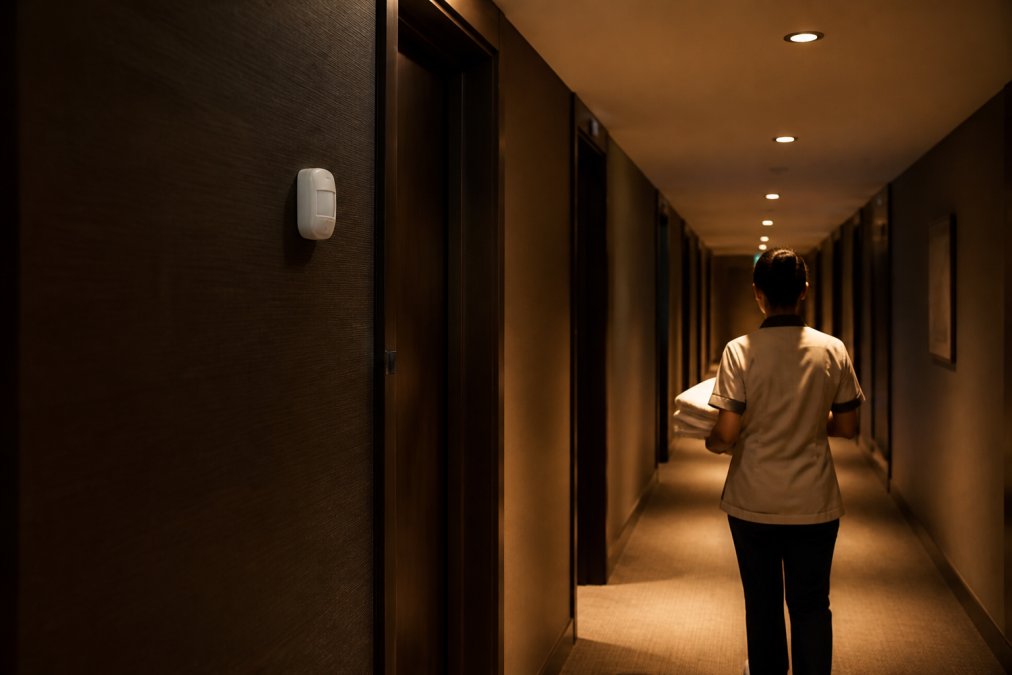
Occupancy-linked control is the highest-yield intervention in most hotels. When a room is unoccupied, HVAC drops to a setback temperature and lighting switches off; when a guest checks in, both restore automatically.
The practical detail that matters: use presence detection rather than key-card slots alone. Guests frequently leave a second card in the slot to keep the room cool, which defeats the entire system. Combined sensors close that gap.
Smart Guest Room Automation: Comfort Without the Complexity
Smart guest room automation gives guests control over lighting, temperature and blinds through a single interface, while keeping the underlying configuration managed by the property. Good installations feel invisible; bad ones make guests hunt for a switch.
Keyless Entry and Contactless Check-In
Mobile keyless entry removes the front-desk bottleneck and cuts physical key replacement costs. Guests receive a digital key before arrival and walk straight to the room.
Where this falls short: it depends on guests actually using their smartphones, and older demographics sometimes prefer a physical card. Run both in parallel rather than replacing cards outright.
Scene-Based Lighting and Climate Presets
Scene presets group multiple settings into one action. A “welcome” scene might bring up soft lighting, set the temperature to 21°C and open the blinds partway (ashrae.org). A “night” scene drops everything to low-level warmth.
AME Electrical configures these scenes during commissioning, so staff do not need to programme anything.
Predictive Maintenance for Hotel Infrastructure
Predictive maintenance for hotel infrastructure uses sensor data to flag equipment problems before failure, turning emergency repairs into scheduled work. The value is less about the technology and more about avoiding a boiler failure on a fully booked weekend.
How Sensor Data Triggers Maintenance Before Breakdowns
Vibration, temperature and current-draw sensors on pumps, lifts and air-handling units establish a normal operating baseline. When readings drift outside that range, the system raises a work order automatically.
The thing nobody tells you about predictive maintenance is that it only works if someone acts on the alerts. A queue of ignored notifications is worse than no system at all, because it creates false confidence. Assign a named person to own the dashboard.
The Connectivity Backbone: Networks and Security Systems
Network infrastructure is the layer that everything else depends on, and it is the one most often under-specified. Cameras, sensors, access control and guest Wi-Fi all share the same backbone.
Segment guest traffic from building systems. If a guest network is compromised, it should not provide a route into room controls or access management. This is basic network hygiene, but plenty of installations skip it.
Where NCSC guidance on network security is clear, it is that separating systems limits how far a single breach can spread. For hotels running dozens of connected devices per floor, that separation is not optional.
Integrating Smart Technology into Existing Hotel Buildings
Retrofitting is almost always harder than new build, and anyone who tells you otherwise has not opened up a ceiling in a 1970s property. The wiring simply may not be there.
A practical sequence for existing buildings:
- Audit what is already installed and what still works
- Identify the highest-return area, usually energy control, and start there
- Confirm the network can carry the additional device load
- Commission in phases, one floor or one system at a time
- Train staff on the interface before going live
Do not rip out working systems to chase a single-brand installation. Mixed estates are normal, and a competent integrator will bring existing devices onto one control layer rather than starting from scratch. Full replacement is the fastest way to waste a budget.
| Priority | System | Typical Payback Driver | Start Here If |
|---|---|---|---|
| 1 | Occupancy-linked HVAC and lighting | Reduced idle consumption | Energy bills are the main concern |
| 2 | Keyless entry | Lower key management costs | Front desk is a bottleneck |
| 3 | Predictive maintenance sensors | Fewer emergency repairs | Plant is ageing |
| 4 | Network segmentation | Risk reduction | Guest Wi-Fi and controls share infrastructure |
What to Ignore When Evaluating Smart Building Technology for Hotels
Plenty of features look impressive in a demonstration and add nothing in daily operation. Voice control in guest rooms is the clearest example: adoption is patchy, and it introduces another point of failure for marginal benefit.
Be sceptical of any system that requires guests to download an app before they can turn on a light. The best interfaces are the ones nobody notices.
Also ignore vendor claims about full automation with no human involvement. Every system needs someone reviewing the data, and any proposal that skips that detail is selling a fantasy. Ask instead who will manage it day to day and what happens when something goes offline.
Running a hotel means every system has to work on the busiest night of the year, not just in a demonstration. AME Electrical designs and installs integrated smart building systems for hotels, combining certified KNX and Nice expertise with a personal, relationship-driven approach from consultation through to ongoing support. We handle the configuration and commissioning so your team is not left managing the technical detail. Get a quote from AME Electrical.
Frequently Asked Questions
What are the benefits of smart building technology in the hospitality sector?
Smart building technology for hotels reduces energy waste by automating heating, lighting and cooling based on room occupancy. It improves guest comfort through personalised room settings and contactless entry. It also gives maintenance teams early warnings when equipment starts to fail.
How does smart building technology improve hotel energy efficiency?
Hotel energy management systems monitor consumption in real time and adjust HVAC and lighting automatically when rooms are empty. Occupancy sensors ensure heating or cooling only runs when needed. Some platforms also track carbon footprint alongside energy use, helping hotels meet sustainability targets and reduce overheads without sacrificing guest comfort.
What is the role of IoT in modern hotel management?
IoT sensors connect room thermostats, lighting, door locks and building equipment to a central platform. This lets staff see and control systems remotely, spot inefficiencies quickly, and automate routine tasks. For example, a sensor can flag a failing air conditioning unit before a guest reports it, allowing predictive maintenance for hotel infrastructure rather than reactive repairs.
What are the key challenges of implementing smart technology in existing hotel buildings?
Older buildings often lack the wiring or network infrastructure that smart systems need. Retrofitting can disrupt operations if not phased carefully. Integration with existing property management systems and mixed-brand devices also adds complexity. Working with an installer experienced in KNX and multi-protocol integration reduces these risks and keeps disruption to a minimum.
How do smart building systems support sustainability goals in hotels?
By automating energy use based on actual occupancy, smart systems cut unnecessary consumption from lighting and climate control. Real-time monitoring highlights where waste occurs, and predictive maintenance keeps equipment running at peak efficiency. Together these reduce a hotel’s carbon footprint and support certification targets without requiring guests to change their behaviour.