
Table of Contents
- What a Smart Home Integration Cost Breakdown Actually Covers
- Smart Home Installation Services Cost: What You Are Paying For
- How the Main Systems Drive the Cost Breakdown
- Smart Home Maintenance and Support Packages Explained
- What Pushes a Quote Up or Keeps It Down
- Phasing a Smart Home Project to Spread the Cost
- Frequently Asked Questions
Last Updated: September 22, 2026
What a Smart Home Integration Cost Breakdown Actually Covers
A smart home integration cost breakdown is the itemised picture of everything you pay for when separate systems, lighting, security, heating and audio, are designed to work as one. It covers hardware, wiring infrastructure, programming time, and the ongoing support that keeps it all running.
Most quotes you receive will not show this. They give you a single figure and a list of rooms.
At AME Electrical, we work on integrated electrical and smart-home projects across the UK and Ireland, from luxury renovations to hospitality venues, and the pattern is consistent: clients who understand the layers behind a quote make better decisions and avoid expensive rework later. This guide unpacks each layer so you can read a quote properly and ask the right questions.
A smart home integration cost breakdown has four layers: hardware, infrastructure and labour, programming and commissioning, and ongoing support. A quote that only prices hardware is not a full picture.
The Four Cost Layers in Any Integrated System
Every integrated system, whether it runs on KNX, a proprietary platform, or a mix of both, splits into four cost layers:
- Devices and hardware – keypads, sensors, dimmers, actuators, touch panels, cameras, and audio equipment
- Infrastructure and labour – cabling, containment, back boxes, distribution boards, and the electrician’s time to install them
- Programming and commissioning – configuring scenes, logic, schedules, and user interfaces, then testing everything together
- Maintenance and support – remote diagnostics, firmware updates, fault visits, and system adjustments over time
Hardware is the layer clients focus on. It is rarely the layer that decides whether a project succeeds.
Smart Home Installation Services Cost: What You Are Paying For
Smart home installation services cost is driven less by the number of devices and more by the work behind the walls. Two homes with identical switch plates can carry very different installation costs depending on cable routes, wall construction, and how much making good is required.
A starter installation for a small home typically begins at £3,000 for a basic package, growing from there to suit the property, the systems specified, and your budget. What matters is understanding what sits inside that figure.
Labour, Containment and Making Good
This is the layer most clients underestimate. Running cable through a finished property means lifting floors, chasing walls, and reinstating plaster and paint afterwards. In a new build or a property mid-renovation, this work is straightforward and cheap. In a finished period home, it can be the single largest line on the quote.
Containment matters too. Trunking, conduit, and cable trays are not glamorous, but they determine whether the system can be extended in five years without opening the walls again.
Skipping containment to save money now is the most common false economy in smart home projects. Adding a single new circuit later in a finished room can cost more than the containment would have, because the walls have to be opened twice.
Programming and Commissioning Time
Programming is where an integrated system becomes usable. It covers scene creation, logic such as “if the alarm arms, drop the heating and kill the downstairs lighting”, app and panel configuration, and full system testing.
This is skilled time, not general labour, and it scales with complexity rather than device count. A ten-room house with straightforward lighting control may take a day. The same house with climate, blinds, audio, and access control interacting together can take considerably longer. Certified KNX and Nice installers carry this competence in-house, which is why the programming line on a proper quote is never an afterthought.
How the Main Systems Drive the Cost Breakdown
The systems you choose shape the cost breakdown more than any other decision. Lighting control, climate, security and access, audio-visual, and networking each carry their own hardware and programming weight, and the way they interconnect determines how much commissioning time the project needs.
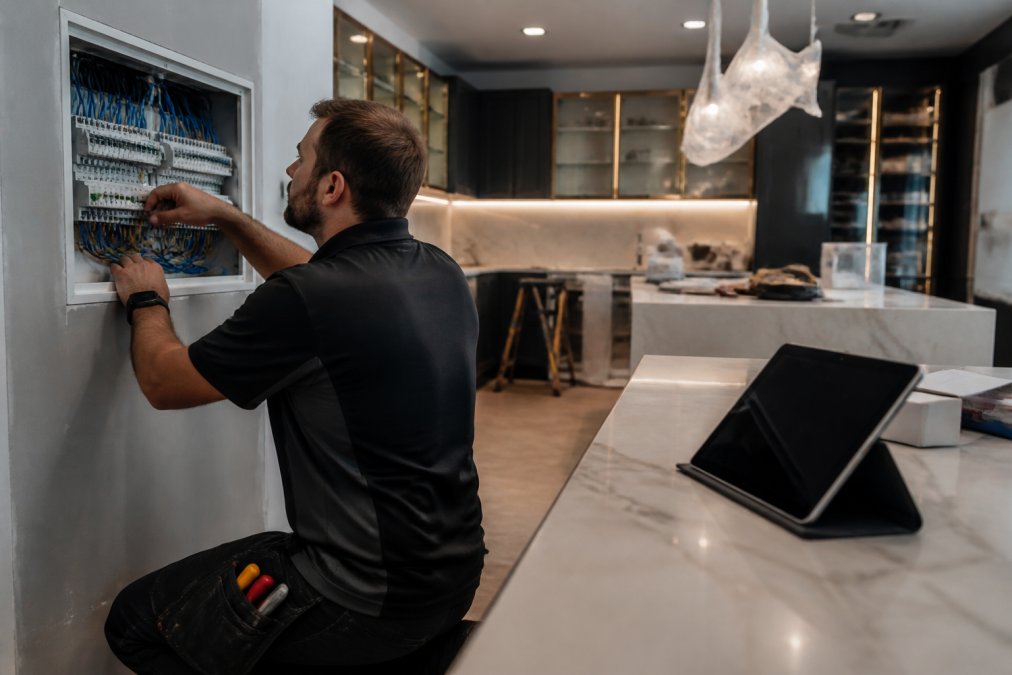
Integrating these complex electrical infrastructures often reveals that the most significant aesthetic and functional value is found in the precise automation of motorized window shades.
Lighting control is usually the largest single system. It touches every room, needs keypads or panels at every entry point, and carries the most programming because scenes are personal. Climate control adds actuators, sensors, and zoning logic. Security and access control bring cameras, door entry, and integration with the lighting and alarm logic.
The cost driver is not any one system. It is the number of interactions between them. A system where the alarm, lighting, and heating all respond to a single “leaving” command costs more to commission than three systems running independently, and it is worth every penny of the difference in daily use.
Smart Home Maintenance and Support Packages Explained
Smart home maintenance and support packages cover what happens after handover: remote diagnostics, firmware and software updates, fault response, and adjustments as your needs change. They are the difference between a system that still works in five years and one that quietly degrades.
The honest answer to “do I need this?” is yes, if the system is integrated. A single smart plug needs no support contract. A whole-home KNX installation with climate, security, and audio does, because firmware updates, network changes, and evolving user expectations all require someone who knows the system.
Ask any installer three questions before signing:
- What is the response time for a fault call?
- Are updates and adjustments included, or billed separately?
- Can you access the system remotely, or does every issue need a site visit?
A package that includes remote access resolves most issues without a van turning up. That is the version worth paying for.
What Pushes a Quote Up or Keeps It Down
Property condition is the biggest single factor. A new build or a property mid-renovation keeps costs down because cabling goes in before plaster. A finished home pushes costs up because every route has to be found and every wall reinstated.
| Factor | Pushes Cost Up | Keeps Cost Down |
|---|---|---|
| Property stage | Finished, occupied home | New build or mid-renovation |
| Wall construction | Solid stone or brick | Stud partition |
| System scope | Many interacting systems | Lighting control only |
| Platform choice | Mixed brands needing integration | Single certified platform |
| Support | Ad hoc, billed per visit | Ongoing package with remote access |
Existing kit is the second factor. If you already own Philips Hue lamps or basic automation, a good integrator will fold what is compatible into the new system and tell you plainly what will not integrate. Rip-and-replace is sometimes necessary, but it is rarely the first answer.
Phasing a Smart Home Project to Spread the Cost
Phasing is the most practical way to manage cost without compromising the end result. The rule is simple: put the infrastructure in first, even for systems you will not fit for years.
Install the cabling, containment, and distribution capacity for the full intended system during the first phase, even if you only fit lighting control now. Cable is cheap during a renovation and expensive afterwards. This single decision saves more than any hardware negotiation.
A sensible sequence looks like this:
- Phase one – infrastructure, distribution board capacity, structured cabling, and lighting control
- Phase two – climate, blinds, and audio-visual, added onto the existing backbone
- Phase three – security, access control, and deeper automation logic as budget allows
Each phase builds on the last without rework. That is the whole point.
Most homeowners approach a smart home project by comparing headline figures, then discover the hard way that a cheap quote often means missing infrastructure, thin programming time, and no support after handover. The cost breakdown exists to prevent exactly that. AME Electrical designs and installs integrated electrical and smart-home systems as certified KNX and Nice installers, handling everything from consultation and design through to installation and ongoing support, so the system you pay for is the system that still works years later. Get a quote and see your project broken down properly, layer by layer.
Frequently Asked Questions
What is the average cost of professional smart home integration?
There is no single average, because the figure depends on how many circuits you integrate, how much wiring is needed and how much programming the system requires. A simple starter pack for a small home begins at £3000 and grows from there, so the honest answer is that a smart home integration cost breakdown has to be built around your property rather than a headline number. Ask for a quote based on your room schedule and the systems you want controlled.
What are the ongoing maintenance costs for a smart home system?
Ongoing costs come from two places: the occasional replacement of failed devices, and an optional support package that covers remote diagnostics, firmware updates and priority call-outs. Smart home maintenance and support packages are priced on the size of the installation and the response times you want, so a small home pays less than a hotel with dozens of controlled circuits. Budget for support as a running cost rather than a one-off, and confirm what is included before you sign.
Can I install a smart home system in stages?
Yes, and it is often the sensible route. A phased approach starts with the wiring and control infrastructure, then adds lighting, climate, security and audio as budget allows. The key requirement is that the first phase must be designed for the finished system, otherwise later stages mean reworking cable routes and control panels. Agree the full design up front, install the backbone first, and add devices room by room.
What is the difference between DIY and professional smart home installation?
DIY suits a handful of app-controlled devices on a single wireless protocol, and the cost is mostly the hardware. Professional installation covers the fixed wiring, containment, certified control gear, programming and commissioning, which is why smart home installation services cost more than a plug-in setup. The trade-off is reliability: a professionally designed system keeps working when the Wi-Fi drops, and it can be serviced and extended rather than replaced.