
Last Updated: November 7, 2026
Quick Summary
Commercial smart lighting systems cost is driven by the control architecture you choose, the number of lighting zones, installation complexity and integration with existing building systems. Budget bottom-up by counting zones, sensors per zone and controlled circuits, then add commissioning and integration as separate lines.
- Wired systems cost more upfront but hold their value longer where reliability matters.
- Commissioning is the line buyers underestimate most, so check whether it is priced per zone.
- Fix six items, including zone schedule and integration scope, before comparing any two quotes.
- Whole-life cost adds running and replacement costs over a ten-year horizon, which can change the ranking.
- Hidden costs cluster in integration, networking, ongoing maintenance and the cost of change later.
Table of Contents
- What Drives Commercial Smart Lighting Systems Cost
- Breaking Down Smart Lighting Installation Costs
- Choosing Commercial Lighting Control Systems That Fit Your Budget
- How Commercial Lighting Energy Savings Affect Your Payback
- Calculating Smart Lighting Return on Investment
- Hidden Costs: Integration, Networking and Whole-Life Expenses
- Getting a Smart Lighting Quote That Reflects Your Building
- Frequently Asked Questions
What Drives Commercial Smart Lighting Systems Cost
Commercial smart lighting systems cost is driven by four things: the control architecture you choose, the number of lighting zones, the complexity of installation, and how well the system integrates with what already runs your building. Get those four right and the budget holds. Get them wrong and the quote doubles after work starts.
Buyers fixate on fittings and ignore the control layer, where most of the money sits.
A lighting control system is the hardware and software that decides when, how brightly and in what combination your lights operate. It includes sensors, dimmers, controllers and the network that connects them.
That definition reframes the budget: you are buying automated, repeatable decisions about light, not lights.
Equipment, Controls and System Architecture
Equipment splits into three cost pools: light fittings and lamps, control gear such as dimmers and relays, and the control platform itself, whether that is a wired KNX bus, a DALI network or a wireless mesh.
Wired systems cost more upfront because of cabling and commissioning, but hold their value far longer where reliability matters more than retrofit speed.
Building Size, Zoning and Installation Complexity
Zoning is the quiet budget multiplier. An open-plan office with five zones is a very different project from a hotel with 90 individually controlled guest rooms, a restaurant, a function suite and external lighting.
Older buildings add cost through access, containment routes and the fact that nothing is where the drawings say it is. A retrofit into a live, occupied building always costs more than a new installation with open ceilings.
Breaking Down Smart Lighting Installation Costs
Smart lighting installation costs break into labour, cabling and containment, commissioning, and project management. Labour is usually the largest single line, and commissioning is the one buyers underestimate most.
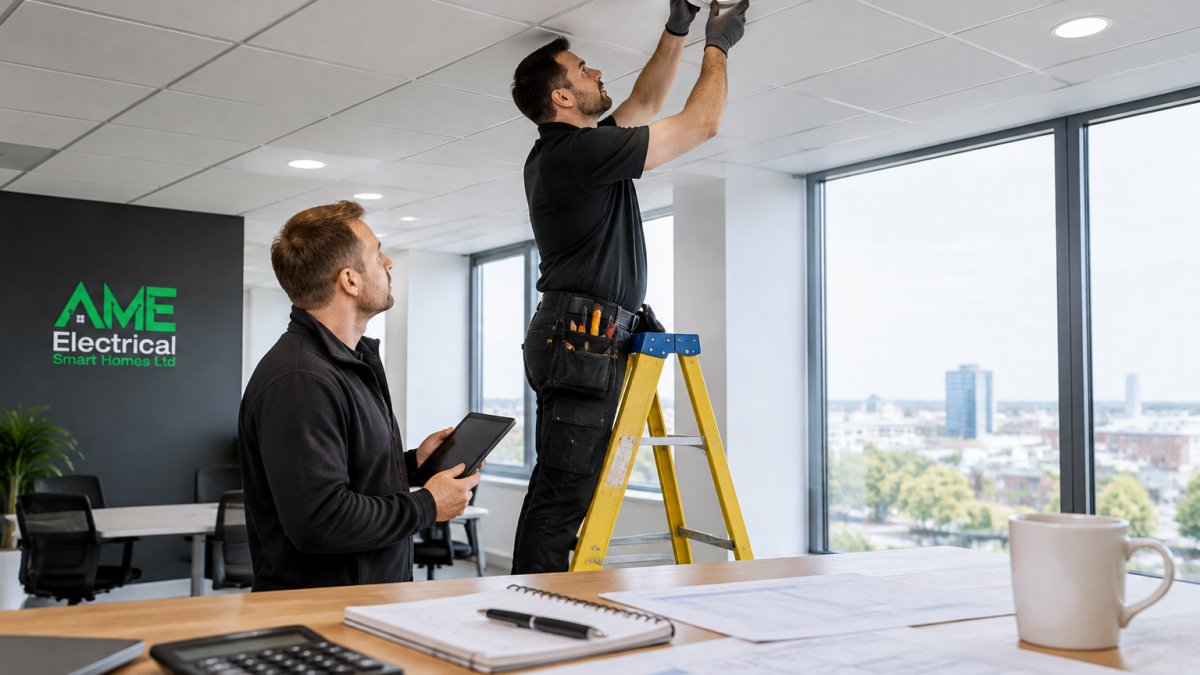
Commissioning is not a formality. Every zone needs addressing, every sensor needs its sensitivity and hold time set, and every scene needs building and testing.
Practical points we would flag before you compare any two quotes:
- Ask whether commissioning is priced per zone or as a lump sum
- Confirm who supplies and terminates the control cable
- Check whether out-of-hours working is included, because occupied buildings often need it
For a sense of how a comparable commercial installation is structured, our breakdown of automated HVAC systems cost for commercial buildings shows the same labour, controls and commissioning split applied to another building service.
Choosing Commercial Lighting Control Systems That Fit Your Budget
The right commercial lighting control system is the simplest one that meets your control requirements and can be maintained by people you can reach.
Three architectures dominate commercial work:
| Architecture | Relative Upfront Cost | Best For | Main Trade-off |
|---|---|---|---|
| Wireless mesh | Lowest | Small retrofits, few zones | Battery upkeep, signal reliability, limited integration |
| DALI | Moderate | Floor-by-floor lighting control | Lighting only, needs a front end |
| KNX with DALI | Highest | Whole-building, multi-system | Higher design and commissioning cost |
DALI handles dimming and individual fitting control well. KNX handles the building: lighting, heating, cooling, blinds and access as one. Our guide to how KNX and DALI work together explains the integration behind much of the hidden cost.
A like-for-like comparison method
Most quotes are impossible to compare because the scope differs. To get a genuine comparison, fix the following before you approach any supplier:
- Building and area, the same floor area, ceiling type and occupancy pattern for every option
- Zone schedule, the same number of control zones and the same sensor logic in each
- Fitting count and type, the same luminaires, so the only variable is the control layer
With those six items fixed, the comparison becomes about control architecture rather than which supplier left the most out.
Indicative budgeting by building type
Rather than quoting a single headline figure, budget per square metre and sanity-check against zone count. The control layer, not the fittings, is where quotes vary most, so treat any per-square-metre figure as a planning allowance refined by a zone schedule.
| Building type | Typical control intensity | What drives the budget |
|---|---|---|
| Open-plan office | Moderate, daylight and occupancy zoning | Sensor density, daylight harvesting, BMS integration |
| Warehouse and logistics | Low to moderate, high-bay occupancy control | Sensor mounting height, aisle zoning, emergency lighting interface |
| Retail | High, scene setting and display control | Scene control, dimming quality, out-of-hours working |
| Hospitality (hotel, restaurant) | High, room-by-room and scene control | Guest room control, back-of-house zoning, integration with access and booking |
| Mixed-use and multi-tenant | Highest, whole-building integration | Network segregation, metering, multi-system coordination |
Build the budget bottom-up: count zones, sensors per zone and controlled circuits, then add commissioning and integration as separate lines. That structure survives finance scrutiny in a way a single lump sum never does.
Where the money actually goes
Across commercial projects, spend splits into four pools: light fittings and lamps, control gear (dimmers, relays, drivers), the control platform and network, and installation and commissioning. Buyers who focus only on the first pool are surprised by the other three. The control platform and commissioning scale with ambition rather than floor area, so a small, highly automated space can cost more per square metre than a large, simply controlled one.
Our KNX lighting control service sets out how scenes, dimming and sensor-based control are designed and programmed.
Best for: hotels, restaurants and multi-zone commercial buildings where reliability matters.
Skip if: you have a single small room and no plans to expand.
Watch out: comparing a wireless quote against a wired quote without fixing the zone schedule and integration scope is not a comparison, it is two different projects with two different totals.
How Commercial Lighting Energy Savings Affect Your Payback
Commercial lighting energy savings come from three places: replacing inefficient fittings with LED, cutting hours through occupancy and daylight sensing, and trimming output through dimming and constant light control.
The first is a straightforward retrofit calculation.
Teams go wrong assuming maximum savings on day one.
Watch out: if nobody owns the system after handover, schedules drift and savings quietly disappear within the first year.
Calculating Smart Lighting Return on Investment
Smart lighting return on investment is calculated by dividing total installed cost by annual saving, giving a payback period in years. Total installed cost must include commissioning, integration and training, not just hardware.
A worked structure, using your own figures:
- Annual saving = current lighting energy spend minus projected spend after controls
- Total installed cost = equipment + labour + commissioning + integration + training
- Payback period = total installed cost ÷ annual saving
Run it three times: conservative, expected and optimistic. If the conservative case still pays back within a period your finance team accepts, the project is sound. If it only works on the optimistic case, it is not.
Whole-life cost, not just capital cost
Payback is a capital-cost measure. Whole-life cost adds the running and replacement costs over a ten-year horizon, and it is where the ranking of options often changes. Build the whole-life model with these lines:
- Energy, current spend versus projected spend, using your actual tariff and your actual operating hours, not a generic average
- Maintenance, lamp and driver replacement, sensor cleaning, battery replacement on wireless systems
- Reprogramming, the cost of reconfiguring scenes and zones after a refit or a change of use
A wired system usually costs more upfront and less over the horizon; a wireless system the reverse. The whole-life model makes that trade-off visible.
Sensitivity analysis: the five variables that move payback
Rather than presenting a single payback figure, present a range and show which inputs drive it. Most practitioners find that five variables account for the bulk of the variation:
| Variable | Why it matters | What to test |
|---|---|---|
| Electricity tariff | Directly scales the annual saving | Low, central and high tariff assumptions |
| Operating hours | Scales both baseline and post-control consumption | Current hours versus a reduced-hours scenario |
| Occupancy pattern | Determines how much occupancy sensing can actually save | Design occupancy versus measured occupancy |
| Maintenance regime | Changes whole-life cost more than capital cost | Reactive versus planned maintenance |
| Financing | Changes the effective cost of capital | Cash versus asset finance versus lease |
A payback that holds across the conservative end of all five is robust. One that only holds at the optimistic end will be questioned in year two.
Making the case credible
Lighting controls rarely stand alone in a business case. Our work on commercial smart building climate control shows how lighting and HVAC controls combine, and combined projects usually shorten payback because the control infrastructure is shared.
Watch out: a payback calculated on a tariff and operating-hours assumption nobody has written down is not a forecast, it is a number that will be replaced the moment someone asks how it was derived.
Hidden Costs: Integration, Networking and Whole-Life Expenses
Hidden costs cluster in four areas: integration with existing systems, network infrastructure, ongoing maintenance, and the cost of change later.
Integration is the big one.
Networking and cybersecurity matter more each year. A lighting system on a building network needs segregation, documented addressing and a patching route, design work that should be priced.
Whole-life cost covers driver and sensor replacement, reprogramming after refits, and support.
Getting a Smart Lighting Quote That Reflects Your Building
A quote that reflects your building is specific about zones, scope, commissioning and exclusions.
Use this checklist when comparing submissions:
- Zone schedule attached, with room-by-room counts
- Control architecture named, with manufacturer and range
- Commissioning priced separately and described
A real commercial KNX and DMX upgrade shows what these decisions look like in practice. Our Hilton Templepatrick lighting control case study walks through the equipment and architecture choices on a live hospitality site.
Budgeting for commercial smart lighting systems cost comes down to specifying the control layer properly before anyone quotes.
AME Electrical works as certified KNX and Nice installers, covering consultation, design, installation and ongoing support. Get started with AME Electrical and budget from a scope that reflects your actual building.
Frequently Asked Questions
How much does a commercial smart lighting system cost to install?
There is no single figure because smart lighting cost depends on building size, the number of lighting zones, whether you are retrofitting or building new, and the complexity of the control system. A small retail unit with basic occupancy sensors sits at a very different level from a hotel with full KNX automation. The only reliable way to budget is to have a qualified installer survey your property and provide a detailed quote based on your actual fixtures, cabling and control requirements.
What factors affect the cost of commercial smart lighting?
The biggest drivers are equipment specification (fixture quality, sensor type, control hardware), installation labour (access, cable runs, whether walls or ceilings need opening), building size and the number of lighting zones, and whether you need integration with existing building management systems. Wireless controls usually cost less to install than wired systems, but wired systems often suit larger, permanent installations better. Energy tariff and operating hours also affect the payback calculation, which influences the overall value case.
How much can businesses save with commercial lighting energy savings?
Savings vary widely by building type and usage pattern, but the main mechanisms are consistent: LED fixtures use far less power than older fluorescent or halogen lamps, occupancy sensors cut lighting in empty rooms, and daylight sensors dim or switch off lights when natural light is sufficient. Combined, these measures can significantly reduce lighting-related electricity consumption. The exact figure depends on your current tariff, operating hours and how much of your lighting is currently left on unnecessarily.
Is smart lighting worth it for a commercial building?
For most commercial properties with regular occupancy, smart lighting is worth evaluating because the savings compound over the system’s life. The smart lighting return on investment comes from lower electricity bills, reduced maintenance (LEDs last far longer than traditional lamps), and in some cases improved compliance with building regulations. The payback period depends on your current lighting, energy costs and how well the system is designed for your occupancy patterns. A poorly specified system can underperform, so professional design matters as much as the hardware.
