
Table of Contents
- What to Look for in a Smart Home Integration Provider
- Smart Home Integration Services UK: The 2026 Landscape
- Luxury Residential Automation: What Sets Premium Projects Apart
- Future-Ready Electrical Infrastructure: Planning for What Comes Next
- How AME Electrical Approaches Complex System Integration
- Comparing Integration Approaches: DIY, Local Electricians and Specialist Integrators
- Frequently Asked Questions
Last Updated: September 23, 2026
What to Look for in a Smart Home Integration Provider
Choosing a smart home integration provider comes down to four things: certified expertise, a single point of accountability, future-ready infrastructure, and genuine aftercare. Price matters, but a cheap install that fails in year three costs far more than one done properly the first time.
At AME Electrical, we see the same pattern on almost every project we inherit. Homeowners start with a few smart plugs and a video doorbell, then add lighting, heating and security piece by piece. Within two years they are juggling four apps and no single system talks to another.
So what actually separates a good integrator from a bad one?
- Certification, not just experience. Manufacturer accreditation proves training on specific platforms, not just general electrical work.
- One system, one controller. Everything should run through a single interface rather than competing hubs.
- Cabling planned for the future. The wiring installed today determines what you can add in five years.
- Support after handover. Ask what happens when something stops working.
That last point is where most quotes fall apart. A provider who disappears after the invoice is cleared leaves you starting over.
Smart Home Integration Services UK: The 2026 Landscape
Smart home integration services in the UK now split into three broad camps: DIY ecosystems, general electricians who wire in smart switches, and specialist integrators who design complete systems. Each suits a different budget and level of ambition. Selecting the right hardware remains the critical foundation for these installations, as the performance of any network ultimately depends on the specific smart home integration devices chosen for the project.
The DIY route works for a flat or a rental. Off-the-shelf hubs and wireless devices are quick to set up and easy to move. The trade-off is reliability. Wireless mesh networks drop devices, updates break automations, and nothing is designed to work together long-term.
General electricians sit in the middle. They can install smart switches and sockets competently, and for a single room that is often enough. What they rarely provide is system design, commissioning, or ongoing support across multiple manufacturers.
Specialist integrators cost more upfront because you are buying design, certified installation and aftercare as one package. For a whole-house project or a commercial venue, that difference shows up in how the system behaves two years later.
The Electrical Safety First guidance on electrical installation work is worth reading before appointing anyone, whatever route you choose.
Why Fragmented Systems Cost More Long-Term
Fragmented systems cost more because every device added to a patchwork setup increases the chance of failure, and each failure needs a different specialist to fix it. There is no single party responsible for the whole system.
A common mistake is buying devices by brand loyalty rather than by whether they speak the same protocol. Philips Hue bulbs, a Nest thermostat and a generic alarm panel may all work individually, but they will not share triggers or scenes without a controller that understands all three.
What most guides miss is the maintenance burden. Every separate app needs updating, every hub needs its own account, and every firmware change risks breaking an automation that used to work. Multiply that across a large property and the admin alone becomes a part-time job.
Mixing ecosystems without a controller that supports them all is the single most common cause of “my smart home stopped working” calls. The fix usually means replacing hubs, not just reconfiguring them.
Luxury Residential Automation: What Sets Premium Projects Apart
Luxury residential automation is defined less by the number of devices and more by how invisibly they work together. In a premium project, lighting, climate, security and audio respond to the house and the people in it, not to a phone screen.
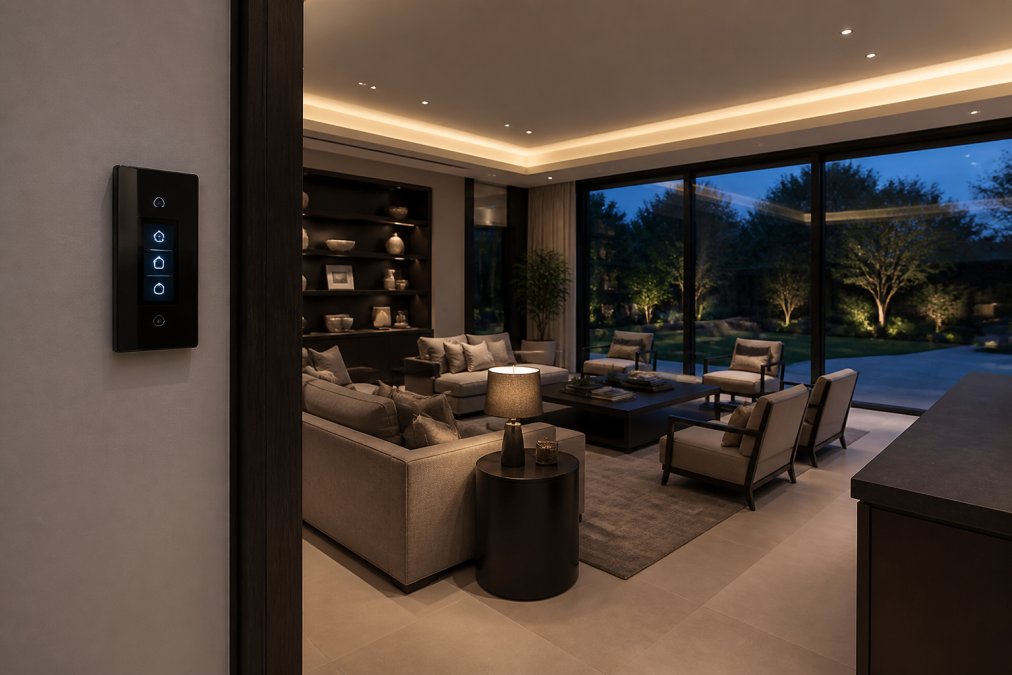
The difference shows up in the details. A hallway lights a path at 2am at 10% brightness rather than full. Heating adjusts per room based on occupancy. Security arms itself when the last person leaves, with no manual input.
None of that happens by accident. It comes from a designer mapping how the household actually moves through the building, then programming scenes around those patterns. Get that stage wrong and you end up with technology that impresses visitors and annoys residents.
Lighting, Climate and Security as One System
Lighting, climate and security should run as one system because they share the same inputs: time, occupancy and occupancy patterns. Treating them separately throws away the intelligence that makes automation worthwhile.
A practical example. When the alarm is disarmed in the morning, the system can raise the kitchen blinds, bring heating up to comfort temperature and switch the hallway to daytime lighting. One action, four outcomes.
Split across three apps, that same sequence takes three manual steps and never quite syncs. The resident stops using it. The system gets blamed.
For hospitality venues, the stakes are higher. A boutique hotel needs room-level control that staff can manage without training, and guests should never see the complexity underneath. Done well, it improves ambience and cuts energy waste at the same time.
Future-Ready Electrical Infrastructure: Planning for What Comes Next
Future-ready electrical infrastructure means cabling and containment designed for systems that do not exist yet. The cost of running extra cable during a build is small. The cost of retrofitting it into a finished property is not.
Three decisions matter most:
- Structured cabling to key points. Data outlets at TV positions, access points and control panels.
- Deep back boxes and adequate containment. Room for modules behind switches and panels.
- A central control location. One place for controllers, network gear and power.
Get these right and adding a new subsystem later becomes a straightforward job. Get them wrong and every upgrade means lifting floors or chasing walls.
Ask any integrator for a cable schedule before work starts. If they cannot produce one, they are installing to a price rather than designing for the building.
How AME Electrical Approaches Complex System Integration
AME Electrical approaches complex integration by treating the electrical installation and the smart systems as one project rather than two. Design, cabling, commissioning and support sit with the same team from first consultation to handover.
That matters because the failure points in most projects sit between trades. The electrician blames the network, the network installer blames the controller, and the homeowner pays for the diagnosis.
Our work covers private residences, hospitality venues and commercial properties. Past projects include Ponderosa Bar & Restaurant, Rosie’s Bar and Hilton DoubleTree Templepatrick, alongside residential schemes where reliability matters more than novelty.
The approach is deliberately relationship-driven. We would rather design a system you will still be happy with in ten years than sell you the most devices this year.
Certified KNX and Nice Installers: What Certification Means for You
Certified KNX and Nice installers have completed manufacturer training and can access the tools, firmware and support channels that unaccredited installers cannot. Certification is not a badge. It is what makes warranty support and future expansion possible.
KNX is an open standard, which means devices from different manufacturers can share one bus and one programming environment (What is KNX?).
Comparing Integration Approaches: DIY, Local Electricians and Specialist Integrators
| Approach | Best For | Design & Commissioning | Ongoing Support | Long-Term Cost |
|---|---|---|---|---|
| DIY ecosystems | Flats, rentals, single rooms | None, self-configured | Self-managed | Low upfront, higher over time |
| Local electrician | Single-room smart switches | Basic wiring only | Ad hoc | Moderate |
| Specialist integrator | Whole-house, hospitality, commercial | Full design and commissioning | Contracted | Higher upfront, lower over time |
Homeowners, hoteliers and property developers running whole-building projects where lighting, climate, security and access need to work as one system with support after handover.
If you are weighing up quotes, ask each provider the same three questions: who commissions the system, who supports it in year three, and what happens if a manufacturer discontinues a device. The answers separate installers from integrators.
Frequently Asked Questions
What should I look for when choosing a smart home integration provider?
Look for certified installers, a track record across residential and commercial projects, and clear post-installation support. Ask whether they handle consultation, design, installation and ongoing maintenance, or just the wiring. Check they can integrate existing devices from brands you already own rather than forcing a full replacement. A provider who explains how your system will stay reliable in five years is more valuable than one who only quotes for the install day.
Are there UK-based alternatives for high-end smart home management?
Yes. Specialist integrators operate across the UK and Ireland, offering KNX-certified installations, lighting control, climate management and security integration. AME Electrical offers a relationship-driven service that covers consultation, design, installation and long-term support so your system does not become orphaned technology.
What are the benefits of professional smart home integration over DIY solutions?
DIY systems work well for single-room setups, but they struggle when you need lighting, climate, security and audio to operate as one. Professional integration ensures devices communicate reliably, scenes trigger correctly and the system scales as you add rooms or buildings. It also means someone else handles updates, troubleshooting and replacements. For luxury residential automation or commercial properties, the reliability and ongoing support matter more than the upfront saving.
How does AME Electrical approach complex system integration?
AME Electrical starts with consultation and design, mapping how you actually use each space before specifying hardware. They are certified KNX and Nice installers, which means they work with open protocols rather than locking you into one brand. The team handles everything from electrical infrastructure to lighting scenes, climate control and access management. After installation, they provide ongoing support so the system stays current and any issues are resolved without you chasing multiple contractors.
What trends are shaping smart home technology in 2026?
Open protocols like KNX are gaining ground over proprietary ecosystems because they let homeowners mix brands without rip-and-replace cycles. Energy monitoring and automated climate control are becoming standard in luxury residential automation, driven by rising energy costs. Security integration, including access control and camera systems, is now expected to work alongside lighting and HVAC rather than as a separate app. Future-ready electrical infrastructure means planning for these additions now, not retrofitting later.