
Last Updated: November 2, 2026
Quick Summary
Smart hotel energy management cuts costs, improves guest comfort and produces clearer reporting. Sub-metering and occupancy-linked controls remove waste, demand forecasting shifts load off peak tariffs, and the resulting data trail supports ESG reporting and UK compliance obligations.
- Meters, sensors and controls must sit on a common platform so one decision acts across several systems.
- IoT applications delivered 68% energy savings in guest-room lighting in a studied hotel.
- Establish a normalised baseline and report verified savings per occupied room-night.
- Phase deployment by area: bedrooms first, then back-of-house, meeting spaces, kitchens and leisure.
- Apply data minimisation so the system knows a room is occupied, not who is in it.
Table of Contents
- How a Hotel Energy Management System Works
- Hotel Energy Monitoring and Analytics: Seeing Where Power Goes
- Hotel HVAC Energy Optimisation Without Losing Guest Comfort
- Occupancy-Based Hotel Room Controls That Cut Waste
- The Main Benefits: Lower Costs, Better Comfort and Clearer Reporting
- What to Plan Before You Install: Costs, Integration and Security
- Getting Your Hotel Energy Management System Specified
- Frequently Asked Questions
How a Hotel Energy Management System Works
A hotel energy management system is the combination of metering, sensing and control hardware that measures how much energy a property uses and automatically adjusts heating, cooling, lighting and other loads to cut waste. The benefits of smart hotel energy management systems come down to one principle: you cannot manage what you cannot see, and you cannot save what you cannot control.
The best systems follow a simple loop. Sensors and meters collect data, an analytics layer turns that data into a picture of where power goes, and controls act on it, dimming lights in empty corridors or easing back heating in unoccupied rooms. That loop repeats continuously, so the building corrects itself rather than waiting for a facilities manager to notice a problem.
The Core Components: Sensors, Meters and Controls
Three component groups do the work:
- Meters: sub-metering at the main intake and on individual circuits shows consumption by area and by system.
- Sensors: occupancy detectors, temperature and humidity probes, and door and window contacts feed live conditions into the system.
- Controls: lighting controllers, HVAC actuators and shut-off relays carry out the decisions the system makes.
The important point is integration. A set of clever sensors that do not talk to the heating and lighting controls saves very little. Connected devices need to sit on a common platform, often a building management system, so one decision can act across several systems at once.
Hotel Energy Monitoring and Analytics: Seeing Where Power Goes
Hotel energy monitoring turns a single monthly bill into a room-by-room, system-by-system picture of consumption. Real-time monitoring is the foundation of every saving that follows, because it exposes the loads that quietly run all night: plant left on, heating fighting cooling, and lighting burning in spaces nobody is using.
Energy analytics adds the interpretation. A good platform establishes an energy-use baseline, then flags departures from it. Department-level energy use becomes visible, so housekeeping, kitchens and leisure areas can each be held to their own target. Predictive analytics and demand forecasting go further, anticipating peak demand and shifting load before expensive peaks are hit. In practice, this is what separates a system that reports from one that acts.
Hotel HVAC Energy Optimisation Without Losing Guest Comfort
Hotel HVAC energy optimisation is the single biggest lever in most properties, because heating and cooling dominate consumption. The goal is not to run plant less; it is to run it only where and when it is needed, without a guest ever noticing.
The most effective approach ties temperature control to room occupancy and to real conditions rather than fixed schedules. For a deeper look at BMS integration and IoT sensors, see our commercial smart building climate control guide. A system can ease heating in a room that has been empty all afternoon, then bring it back to the guest’s preferred setting before check-in. Temperature monitoring across zones also catches plant that is overworking, which usually signals a maintenance issue rather than a genuine demand for heat.
SENER’s work on smart hotel energy consumption describes using real-time data to anticipate demand and dynamically adjust climate-control systems, reporting a 25% decrease in climate-control energy demand and a 15% reduction in total electricity consumption.
Occupancy-Based Hotel Room Controls That Cut Waste
Occupancy-based hotel room controls cut waste by matching energy use to whether a room is actually in use. Guest-room lighting is where the effect is starkest: a study listed by the London South Bank University research portal reports energy savings of 68% in guest-room lighting and 34.4% in lighting overall from IoT applications in a studied hotel.
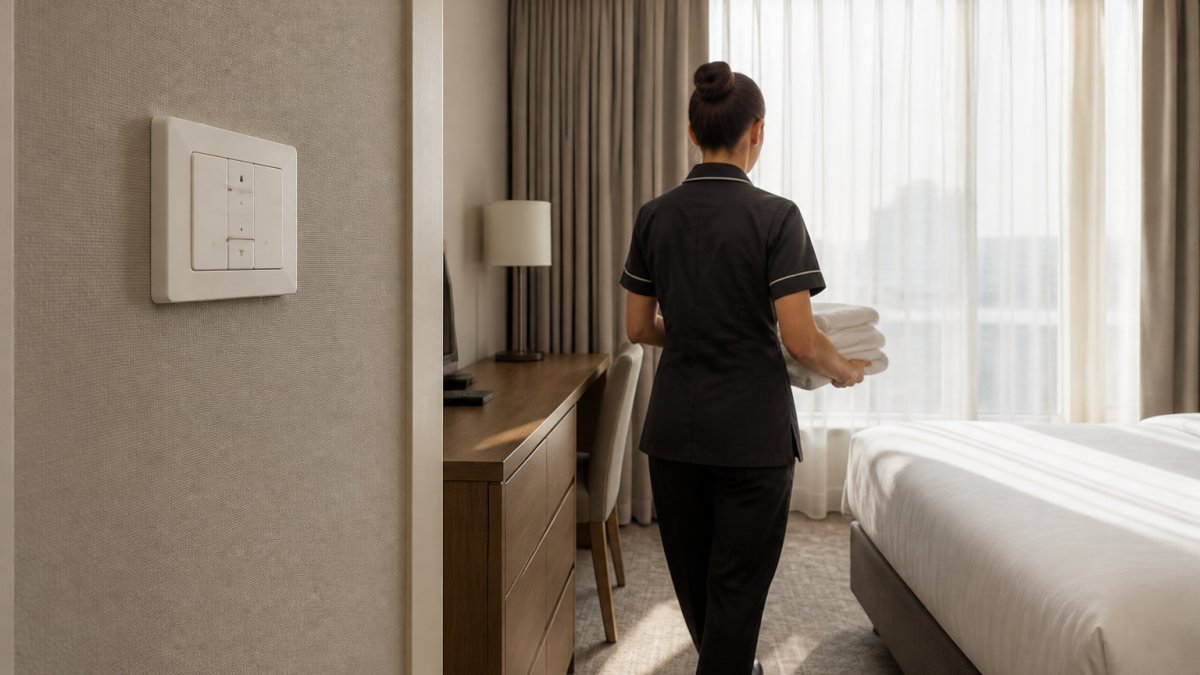
Occupancy detection makes this possible. When a room is empty, the system drops lighting to a safe minimum, eases heating or cooling back, and closes off unnecessary loads. When a guest returns, settings restore. The same logic works in corridors, back-of-house areas and meeting rooms. Pairing occupancy controls with the right fittings matters too.
The Main Benefits: Lower Costs, Better Comfort and Clearer Reporting
The benefits of smart hotel energy management systems fall into three groups, and the strongest business case usually rests on all three at once. What separates a credible business case from a sales pitch is being able to show, mechanism by mechanism, how each benefit is produced and how it is proved.
- Lower operational costs. Reduced energy consumption feeds straight through to utility costs, and the effect compounds across a portfolio. The mechanism is straightforward: sub-metering identifies the loads that run when they should not, occupancy-linked controls remove the waste, and demand forecasting shifts consumption away from expensive peak periods. Because most properties buy electricity on half-hourly or similar time-of-use tariffs, shifting load away from peak windows can lower the effective unit rate as well as the total units consumed.
- Better guest comfort. Zoned control keeps rooms at the right temperature and light level instead of heating and lighting empty space. The mechanism matters here: comfort improves not because the system runs plant harder, but because it stops heating and cooling fighting each other and stops rooms being conditioned hours before they are needed. A well-commissioned system restores a guest’s preferred settings on return, so the saving is invisible to the guest.
- Clearer reporting. Energy data becomes an audit trail. Verdant’s 2026 hotel sustainability trends notes that energy management systems generate the data trails needed for accurate ESG reporting, which increasingly matters to owners, investors and corporate clients. In the UK context, that trail also supports streamlined energy and carbon reporting obligations for larger organisations and the energy performance certificate regime for buildings, so the same data serves both commercial and compliance purposes.
There are operational gains too: equipment performance data supports preventive maintenance and cuts equipment downtime, and department-level targets give teams something concrete to manage against. A common pattern is that the maintenance benefit is undervalued at the specification stage and turns out to be one of the most durable returns, because a plant item that is trending out of tolerance is caught before it fails in an occupied wing.
Proving the Savings Are Real
The figures are not theoretical, but the more important point is measurement. A Hilton DoubleTree Templepatrick project is one example of intelligent control delivered on a live hospitality site.
To distinguish a genuine improvement from normal variation, establish a baseline before installation and normalise for occupancy and weather afterwards. Most practitioners report energy-use intensity per occupied room-night as the most defensible metric, because it removes the effect of a good or bad trading month.
Watch out: the most common failure is installing controls without commissioning them properly against real occupancy patterns.
If you want to see how energy management fits alongside HVAC, lighting, security and predictive maintenance, our smart building technology for hotels guide sets out the full picture.
The article groups the benefits of smart hotel energy management into three areas, each with a clear mechanism behind it.
| Benefit | How it is produced | What it delivers |
|---|---|---|
| Lower operational costs | Sub-metering, occupancy-linked controls, demand forecasting | Reduced utility costs; load shifted off peak tariffs |
| Better guest comfort | Zoned control; settings restored on guest return | Right temperature and light without conditioning empty space |
| Clearer reporting | Energy data becomes an audit trail | Supports ESG reporting and UK compliance obligations |
| Operational gains | Equipment performance data; department-level targets | Preventive maintenance and less equipment downtime |
What to Plan Before You Install: Costs, Integration and Security
Plan the integration and the data governance before you sign anything, because these decide whether the system still works well in five years. The practical sequence most successful projects follow is: survey and baseline, integration design, phased deployment, then measurement and verification.
Survey and baseline. Start with an energy-use baseline so savings can be measured and verified against something real.
Integration design. Confirm that new controls will integrate with existing plant and with any building management system already on site.
Cost categories. Costs fall into survey and design, hardware (meters, sensors, controllers and actuators), integration and commissioning, and ongoing support and maintenance.
Cybersecurity and data governance. Agree who holds the energy data, where it sits, and how access is controlled, since connected devices and occupancy data are sensitive.
Trade-offs and limitations. Be realistic about sensor accuracy, guest overrides and comfort complaints. Occupancy sensors can misread a still guest as an absent one, so pair them with door contacts and allow a generous unoccupied delay.
Watch out: the most common planning failure is treating cybersecurity and vendor responsibilities as something to settle after installation. Once devices are live and holding occupancy data, retrofitting access controls and patching obligations is far more disruptive than agreeing them up front.
Getting Your Hotel Energy Management System Specified
The gap between a system that saves energy and one that becomes an expensive ornament is specification and support. At AME Electrical, we are certified KNX and Nice installers, and we handle the work from consultation and design through to installation and ongoing support, so the controls stay tuned to how your property actually operates.
If you are planning a refurbishment or a new build, the earlier we are involved, the more cleanly the energy controls integrate with lighting, HVAC and access systems.
Frequently Asked Questions
What is a smart hotel energy management system?
It is a connected set of sensors, smart meters and controls that monitor and adjust a hotel’s energy use in real time. Rather than running heating, cooling and lighting on fixed timers, the system responds to actual room occupancy, outdoor conditions and demand. Managers get a dashboard showing where power is going, and the system can automatically power down empty rooms, trim peak demand and flag equipment that is running inefficiently. It links building systems such as HVAC, lighting and refrigeration into one view so decisions are based on live data rather than guesswork.
How do hotel energy management systems reduce energy use?
Most savings come from stopping energy being spent on empty or half-used spaces. Occupancy sensors switch off lighting and ease back heating and cooling in unoccupied rooms, while analytics highlight equipment running outside its normal pattern. Real-time monitoring also exposes peak demand periods so load can be shifted or trimmed.
How can hotels balance energy efficiency with guest comfort?
The key is setting comfort bands rather than fixed temperatures. A room can drift a degree or two while empty and return to the guest’s preferred setting before check-in, so nobody notices a difference. Occupancy-based hotel room controls should always keep a manual override within reach, and lighting should dim rather than cut out. Set the system’s limits with your operations team, test them in a small block of rooms first, and review guest feedback alongside the energy data before rolling out across the property.
How can hotels measure whether an energy management system is working?
Establish an energy-use baseline before installation, ideally 12 months of utility and meter data broken down by department. After commissioning, compare like-for-like periods and normalise for occupancy and weather so seasonal swings do not distort the result. Hotel energy monitoring and analytics platforms generate the data trail needed for this, and the same records support sustainability and ESG reporting. Review equipment performance monthly, watch for unexplained spikes, and use the findings to prioritise targeted upgrades rather than wholesale replacement.
The challenge is not choosing clever hardware; it is making meters, sensors and controls work as one system that your team can actually run. That is the part we specialise in. Get started with AME Electrical and specify a hotel energy management system built around your property, backed by certified installation and support that continues after handover. Get a quote to begin.
