
Quick Summary
KNX vs traditional wiring is a choice between a dedicated data bus and direct mains circuits. KNX connects lights, switches and sensors over one low-voltage bus cable, so control is set by software rather than copper. Traditional wiring is simpler and cheaper per point, but changing what a switch does usually means rewiring.
- KNX uses one dedicated bus cable to connect sensors, push-buttons and actuators.
- Traditional wiring runs a separate switched circuit from each switch to each light.
- KNX suits new builds, where cable routes are open before plasterboard goes up.
- KNX commissioning needs specialist software and training, unlike conventional installation work.
- Ask for lifetime costs, not just installation costs, when comparing quotes.
Table of Contents
- How KNX and Traditional Smart Home Wiring Differ
- KNX Wiring Requirements Compared Cable by Cable
- KNX Installation for New Builds: Where the Case Is Strongest
- KNX Retrofit Installation and Wireless Alternatives
- Itemised Costs: Installation and Lifetime Ownership
- The KNX Commissioning Process and Ongoing Support
- Choosing Your Next Step for Your Property
- Frequently Asked Questions
How KNX and Traditional Smart Home Wiring Differ
When weighing up the knx vs traditional question, KNX is an open-standard bus system that connects lights, switches, sensors and heating controls over a dedicated data cable, while traditional wiring runs individual circuits from each switch straight to each load.
Traditional smart home wiring usually means conventional switched mains circuits, sometimes with smart switches or relays added on top. KNX adds a separate communication layer on top of a structured installation. In practice, the knx vs traditional choice is not always either-or, and many projects use both.
How KNX Bus Wiring Works
In a KNX system, push-buttons, sensors and actuators share a single bus cable. Each device sends and receives messages rather than being hard-wired to one specific light.
This means the cable runs are shorter and more predictable. It also means the system’s intelligence is spread across the devices instead of sitting in one central box. That distributed design is why KNX is often described as resilient, though it still depends on correct programming and commissioning.
How Conventional Mains Wiring Handles Control
Conventional wiring runs live conductors from a distribution board to each light point, then from each light point back to its switch. Every switch controls the circuit it is physically connected to. Changing what a switch does usually means rewiring it, which is difficult once plaster and fittings are in place.
Simple, familiar and inexpensive per point, conventional wiring works well for homes with fixed, straightforward control needs. Its limits show up when a household wants scenes, schedules, or control from a phone.
KNX Wiring Requirements Compared Cable by Cable
The clearest way to understand the difference is to follow one lighting circuit from the distribution board to the lamp, first conventionally and then on KNX.
A conventional lighting circuit, point by point
A conventional circuit runs a live conductor from the distribution board to the light point, then a switched live from the light point down to the switch, with neutral and earth following the same route. The switch interrupts the live conductor. Every switch is physically tied to the circuit it controls, so the function of a switch is fixed by copper. Adding a second switch to the same light means another cable run; adding a scene means adding hardware at the switch or in the board.
The same circuit on KNX
The mains side barely changes: a live, neutral and earth still run from the distribution board to the light, and the light is still switched by a relay or dimmer channel. What changes is where that relay sits and what controls it.
That is why the cable schedule looks so different. On KNX, the bus cable daisy-chains from device to device around the property, and the mains cable runs from the cabinet to each load without detouring to the switches.
What the comparison means in practice
- Bus cable: one dedicated data cable serving many devices, routed to each sensor, push-button and actuator. It carries low voltage and is kept separate from mains where required.
- Mains cable: separate live, neutral and earth circuits for each load, terminating at the actuator in the cabinet rather than at a wall switch.
- Central cabinet: KNX actuators are typically housed in a wiring cabinet sized for the number of channels, while conventional circuits terminate at the distribution board with no actuator layer.
- Containment: both approaches need conduit or trunking where cable cannot be buried, but KNX concentrates the complexity in the cabinet and simplifies the wall drops.
Standards, safety and installer competence
Both approaches are fixed wiring and fall under the same electrical safety framework. The difference is competence: conventional work is within the scope of any competent electrician, while KNX commissioning needs specialist software, tools and training. Ask for evidence of both the electrical qualification and the KNX commissioning experience, and ask what documentation you will receive at handover.
Watch out: a design that routes the bus cable without allowing for future sensor positions can leave you unable to add control points later without opening walls, which defeats the main advantage of the bus.
KNX Installation for New Builds: Where the Case Is Strongest
New builds are where KNX makes the most sense. See a KNX assisted living installation in Donegal for how this plays out in a finished home.
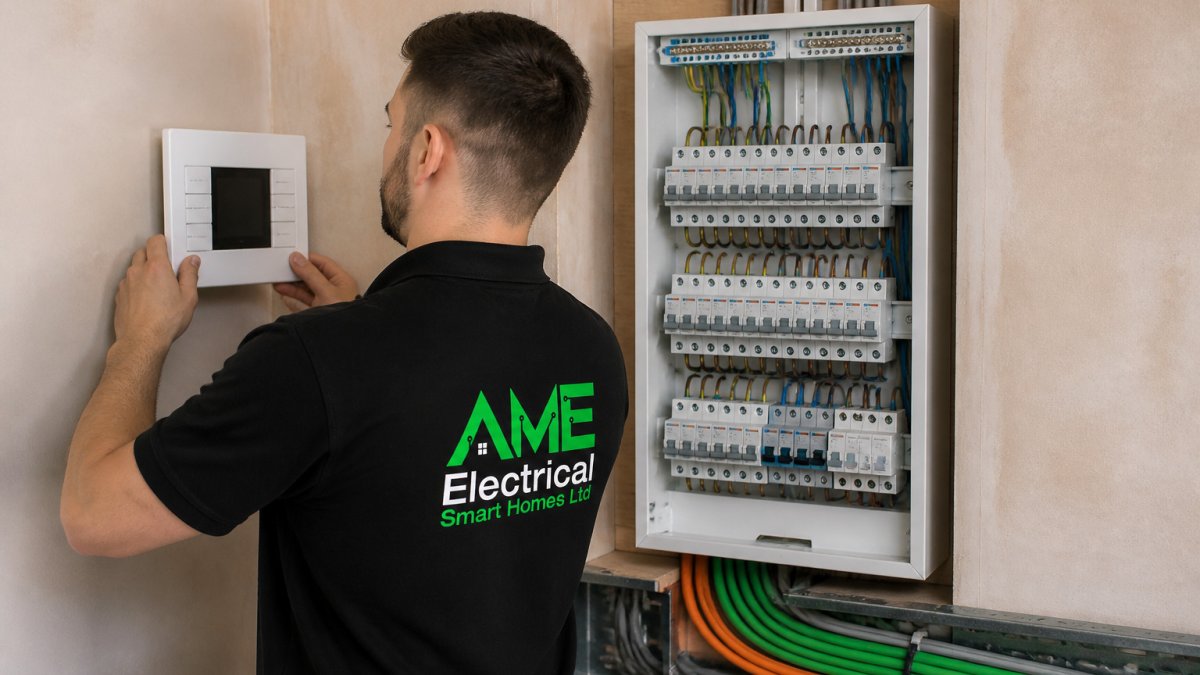
A KNX installation for a new build also gives you more room to change your mind. If you want to understand how these devices talk to other platforms, read how KNX connects to Home Assistant.
Planning lighting, heating and blind zones before the first-fix stage begins helps a new build take full advantage of a KNX installation. Browse an architect-led KNX smart home in Maghera to see how zones were laid out in a self-build.
KNX Retrofit Installation and Wireless Alternatives
Retrofitting KNX into an existing home is harder. Bus cable has to be routed through finished walls or surface trunking, which adds time and disruption. This is where wireless alternatives come into the picture.
A smaller retrofit may be better served by a hybrid approach: KNX backbone where cable already exists, and wireless devices for the rest.
Common retrofit mistakes include underestimating the cable routing effort and assuming wireless devices will be as stable as a dedicated bus.
Itemised Costs: Installation and Lifetime Ownership
Most comparisons stop at “KNX costs more up front”. That is true but useless on its own, because the up-front figure hides where the money actually goes and where the two approaches diverge over a decade or more. The honest way to compare is to price each cost line separately, state the assumptions behind it, and then decide. Pricing depends on property size and specification, so the structure below shows what a quote should itemise.
The five cost lines to price separately
- Hardware per control point. A conventional installation needs a switch, a back box and a length of cable per point. A KNX installation needs a bus device (push-button interface, sensor or actuator channel) plus the bus cable and a power supply. Pricing depends on property size, the number of control points and the level of integration, so contact AME Electrical for a quote tailored to your project.
- Cable and containment. Conventional wiring uses more mains cable because every switch runs to its load. KNX uses less mains cable but adds a dedicated bus cable, plus trunking or conduit where it cannot be buried. On a new build the containment cost is often similar; on a retrofit it is where the budget moves most.
- Labour and first fix. Conventional first fix is fast and familiar, so labour per point is predictable. KNX first fix is comparable in time but demands more planning before a cable is pulled, because every sensor position and actuator location must be decided in advance.
- Commissioning and programming. This is the line conventional quotes usually omit entirely and KNX quotes sometimes bury. Assigning addresses, building scenes, testing every zone and documenting the result takes specialist time, and it scales with the number of zones rather than the number of rooms. A 19-zone heating and 80-circuit lighting scheme is a materially bigger commissioning job than a single-zone flat.
- Maintenance, updates and future changes. Conventional systems need little beyond periodic inspection and testing of the fixed wiring. KNX needs occasional software updates and, if the homeowner wants changes, reprogramming time. The trade-off is that a change on KNX is usually a programming task rather than a rewiring task, which is where the lifetime cost can swing back in its favour.
How to read a quote
Ask for the five lines above as separate items, not one lump sum. A quote that bundles hardware, labour and commissioning into a single figure makes it impossible to compare against a conventional tender, and it hides whether the commissioning allowance is realistic. Ask what assumptions the price rests on: number of control points, number of zones, whether containment is included, and whether documentation and handover training are in scope.
Watch out: a KNX quote that looks competitive on hardware often understates commissioning, and the shortfall surfaces after first fix when changes are expensive.
Lifetime ownership, not just day one
The lifetime comparison turns on three questions. How often will the household want to change what a switch does? How likely is a replacement part to be available in ten years? And how dependent will the system be on one installer? A bus system that can be reprogrammed cheaply answers the first well; an open standard with multiple manufacturers answers the second better than a proprietary system; and good handover documentation answers the third. Price those three risks alongside the invoice, because they are where the real lifetime cost sits.
The KNX Commissioning Process and Ongoing Support
Commissioning is the stage where devices are programmed, addresses are assigned and every scene is tested. It requires specialist software and tools, and a poorly commissioned KNX system can be difficult to repair without the right expertise.
Once commissioned, a well-built system should run reliably with occasional updates. Choose an installer who will still be available after handover. If you want to move ahead, professional KNX installers in Ireland can scope the commissioning work for your property.
Choosing Your Next Step for Your Property
The right choice depends on your building stage, budget and how much control you want. KNX suits new builds and substantial renovations where the cable route is open and long-term flexibility matters. Conventional wiring with selective smart devices suits smaller refurbishments with simpler needs.
Our recommendation is to start with a clear list of what you want to control, then ask for a site assessment. Once you have that, request a quote from AME Electrical for a written scope that matches your property.
Frequently Asked Questions
What is the difference between KNX wiring and traditional wiring?
Traditional lighting and switching usually run a dedicated mains cable from each switch to each light or outlet, so control is fixed by the wiring route. KNX uses a separate low-voltage bus cable linking sensors, switches and actuators, and the actuators switch the loads. This means one control point can operate any circuit on the bus, and changing a function is usually a matter of reprogramming rather than rewiring. The trade-off is that a KNX installation needs bus cable at every intended switch and sensor position and proper commissioning, which is planned from the start.
Can KNX work with conventional electrical wiring?
Yes. Most KNX installations keep the existing mains supply to lights, sockets and appliances and add a KNX bus alongside it. The actuators are typically fitted in a central distribution or wiring cabinet, where they switch the mains circuits. Existing light fittings and loads can often remain in place, although each circuit to be controlled needs to pass through an actuator. A site survey confirms which circuits can be brought under control before any work starts.
Is KNX suitable for a home renovation?
KNX suits renovations where walls are open or where a substantial rewire is already planned, because the bus cable has to reach every intended sensor and switch position. In a finished property with no access, wireless options may be easier to fit, though they trade some stability for convenience. The right answer depends on how much of the building is accessible and how many control points are needed.
What should I ask an installer before choosing KNX?
Ask whether the installer holds KNX certification, how they will test and commission the system, and what documentation you will receive at handover. Ask how the system will be expanded later, who supports it after installation, and what the support arrangement costs. Request an itemised quotation separating hardware, cable, labour and commissioning. Pricing depends on property size, number of control points and the level of integration, so contact AME Electrical for a quote tailored to your project.
Get started with AME Electrical for a KNX design that fits your home, with certified KNX and Nice installers handling consultation, installation and ongoing support.
