
Last Updated: 30 October 2026
Quick Summary
Upgrading legacy electrical systems to KNX in Ireland replaces ageing wiring, switches and control gear with one open-standard bus system running lighting, heating, blinds and security from a single platform. Existing power circuits usually stay, while the control layer is replaced with bus devices and actuators.
- KNX runs on its own twisted-pair bus cable, separate from mains power.
- Older homes often have lighting circuits with no neutral at the switch, which changes the plan and labour.
- A quote issued without a site survey is a guess, so always insist on a survey first.
- Commissioning happens in ETS, the manufacturer-independent software used to program KNX devices.
- Keep the ETS project file current after any change to support long-term maintenance.
Table of Contents
- Why Upgrade Legacy Electrical Systems to KNX?
- KNX Compatibility with Existing Wiring
- Assessing Your Legacy System Before a KNX Retrofit
- KNX Integration with Existing Systems
- KNX Installation and Commissioning: What to Expect
- KNX System Maintenance and Long-Term Support
- Get a Quote for Your KNX Upgrade
- Frequently Asked Questions
Why Upgrade Legacy Electrical Systems to KNX?
Upgrading legacy electrical systems to KNX in Ireland is the process of replacing ageing wiring, switches and control gear with a single open-standard bus system that runs lighting, heating, blinds and security from one platform. A beautiful house wired to a patchwork of apps that nobody can operate two years later is a common outcome of fragmented systems.
The appeal is straightforward. One protocol, one app, one installer, and a system that keeps working when the manufacturer of your smart bulbs quietly discontinues them.
Legacy systems can become difficult to extend in several common ways, including fragmented apps and accounts and undocumented installations.
KNX is a building control standard that lets devices from different manufacturers share one bus cable and one programming language. That matters more than any single feature. It means you are not locked to one brand for the life of the building.
If you want the groundwork explained before you commit, our guide on upgrading legacy electrical systems for smart home technology covers the fundamentals.
KNX Compatibility with Existing Wiring
KNX compatibility with existing wiring depends on whether the cable can support the bus. KNX runs on its own twisted-pair bus cable, separate from mains power. Your existing power circuits usually stay. The control layer is what gets replaced.
In practice, a retrofit can take several forms depending on the property.
The old switches come out. In their place go bus devices and actuators, usually housed in a distribution board or a dedicated cabinet. Sensors and panels connect to the bus, and each device gets a physical address during commissioning.
One thing catches people out. Older homes often have lighting circuits with no neutral at the switch. That is a wiring detail, not a KNX limitation, but it changes the plan and the labour. A survey settles it before anyone quotes.
For a fuller breakdown of topology, cables and trade-offs, read our KNX versus standard electrical wiring comparison.
Assessing Your Legacy System Before a KNX Retrofit
A proper assessment answers three questions: what works, what can be reused, and what has to go. Skipping it is the most common way retrofits run over budget.
A proper assessment typically begins with a site survey and review of any existing documentation.
What we check:
- Cable condition and insulation resistance on circuits marked for reuse
- Consumer unit capacity and spare ways for new actuators
- Earthing and bonding arrangements
- Existing containment: trunking, conduit and ceiling voids for the bus route
- Any third-party devices the owner wants to keep
Then comes the honest conversation. Some legacy equipment is worth integrating. Some is not, and keeping it adds cost and fragility for no real gain.
Watch out: a quote issued without a site survey is a guess. Cable routes through a finished period property can change the labour substantially, and that surprise always lands on the client.
KNX Integration with Existing Systems
KNX integration with existing systems works through gateways, and most household devices can be brought onto the bus rather than replaced. That includes audio, AV, access control and many consumer smart devices.
A gateway can act as a translator between the KNX bus and another device’s protocol, exposing that device’s functions as KNX objects.
What integrates less well: cheap cloud-only devices with closed APIs. They can often be made to work, but the reliability sits with a third party’s server, not your building.
A common question is whether existing devices from different brands can be integrated or need replacing. Our guide on integrating existing smart home devices walks through compatibility and troubleshooting.
KNX Installation and Commissioning: What to Expect
Expect a phased job: first fix, then bus wiring, then commissioning, then handover with documentation. Commissioning is where KNX differs most from conventional electrical work, and it is where a good installer earns their fee. If you are at the point of choosing who does the work, our guide on hiring a professional KNX installer in Ireland explains what to check before you hire.
Typical sequence:
- Design and addressing plan. Rooms, functions and group addresses agreed on paper first.
- First fix. Bus cable, back boxes and containment installed alongside power.
- Device installation. Actuators, dimmers, sensors and panels fitted.
- Commissioning in ETS. Every device programmed, every group address tested.
- Scene setting and handover. Scenes tuned with the client present, documentation issued.
ETS is the manufacturer-independent software used to program KNX devices. It is why any certified installer can service the system later, not just the one who fitted it.
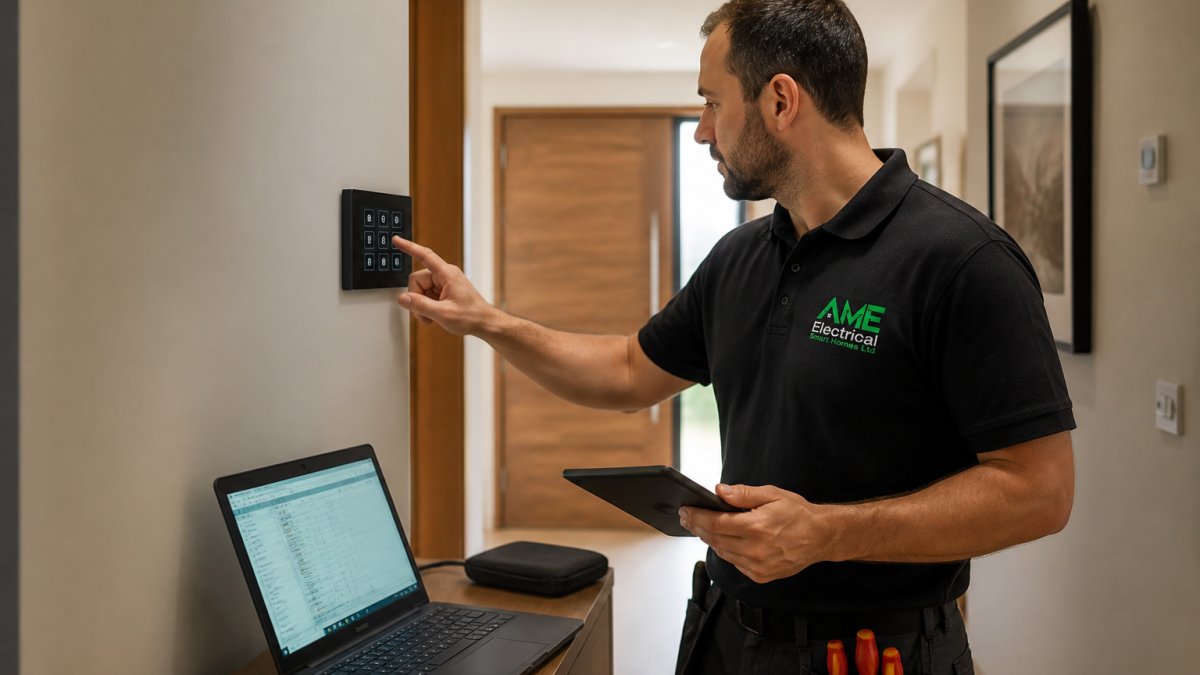
Handover documentation, such as the ETS project file and a group address list, helps whoever maintains the system later.
Here is the typical sequence of a KNX retrofit, from design through to handover.
| Stage | What happens |
|---|---|
| Design and addressing plan | Rooms, functions and group addresses agreed on paper first |
| First fix | Bus cable, back boxes and containment installed alongside power |
| Device installation | Actuators, dimmers, sensors and panels fitted |
| Commissioning in ETS | Every device programmed, every group address tested |
| Scene setting and handover | Scenes tuned with the client present, documentation issued |
KNX System Maintenance and Long-Term Support
KNX maintenance is largely about documentation and access rather than repairs, and a well-commissioned system generally needs little routine attention.
What actually needs doing:
- Keep the ETS project file current after any change
- Label devices and group addresses clearly at the board
- Test scenes and schedules after any building work
- Check gateway firmware where third-party devices are involved
- Log faults with dates so patterns become visible
A common concern is being left without support after installation, so it is a fair question to ask any installer before signing. For practical diagnostics when something does go wrong, see our guide on how to troubleshoot KNX home automation systems.
Get a Quote for Your KNX Upgrade
Upgrading legacy electrical systems to KNX in Ireland is a planned project, not a like-for-like swap. The buildings that go smoothly are the ones surveyed properly, documented fully and commissioned by certified installers.
AME Electrical is a certified KNX and Nice installer working across private and commercial projects. The business provides consultation, design, installation and support.
Pricing depends on property size, circuit count, the condition of existing wiring and how much third-party equipment needs integrating. Visit the AME Electrical website or request a quote for current pricing.
Get started with AME Electrical and a KNX system your building can grow into.
Frequently Asked Questions
Can an existing electrical system be upgraded to KNX?
In most cases, yes. A KNX retrofit is possible on many legacy electrical systems, but it depends on the condition of your wiring, the type of circuits you have and how much control you want. A qualified KNX installer will assess the existing installation first, then recommend whether a full rewire, a partial retrofit or a hybrid approach is the most practical route for your property.
Can KNX work with existing wiring?
KNX can often reuse existing mains wiring for lighting and power circuits, which reduces disruption. The KNX bus cable itself is new and separate, so it needs to be routed to switches, sensors and actuators. Compatibility with existing wiring is one of the first things to check: old rubber-insulated cables, undersized circuits or a lack of earth continuity may need attention before any KNX installation and commissioning begins.
How does a KNX upgrade affect existing switches and lighting controls?
Traditional switches are usually replaced with KNX push-button interfaces or touch panels, and dimming moves from the switch to a KNX actuator in the distribution board. Existing light fittings can often be kept if they are compatible with the chosen dimming method. Your installer will confirm which fittings work with the new controls and whether any lamps need changing to avoid flicker or limited dimming range.
How can a legacy control system be upgraded without replacing everything?
A staged upgrade is often the answer. KNX integration with existing systems lets you keep working heating, security or audio equipment and bring it under one control layer through gateways. The installer maps what can stay, what needs replacing and what can be added later, so you spread cost and disruption across phases rather than stripping everything out at once.
